
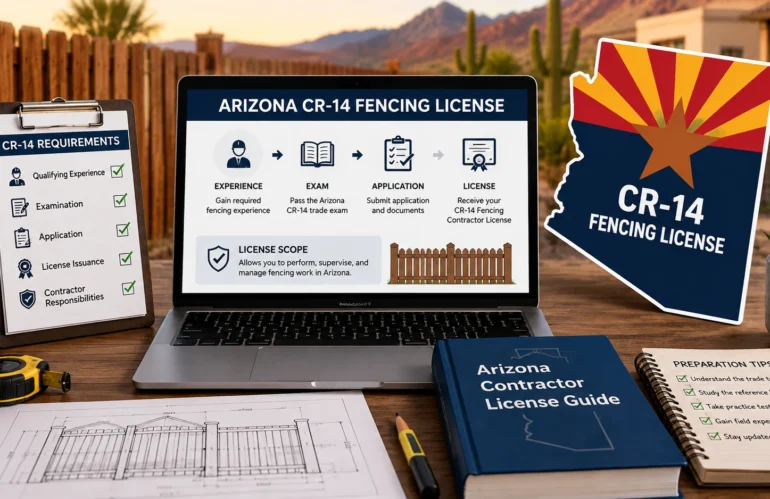
Thinking about getting an Arizona CR-14 Fencing contractor license? Before you schedule an examination or start preparing paperwork, it is worth understanding what Arizona actually requires from a qualifying party.
CR-14 is a specific Arizona contractor classification for fencing work. The Arizona Registrar of Contractors (AZ ROC) currently identifies CR-14 as the Fencing classification and lists a three-year experience requirement along with the applicable examination requirements.
That makes the licensing process more than a simple “pass the test and start working” situation.
Your experience, qualifying-party status, examinations, business information, application, and classification all fit together.
For someone who has already worked in fencing, the process may feel straightforward at first. For someone coming from a related construction trade, however, questions can appear quickly.
Does general construction experience count?
Does residential fencing experience qualify?
What exactly does the qualifying party need to demonstrate?
Which exams are required?
What does CR-14 actually allow you to do?
And what happens if your planned project includes work outside the fencing classification?
This guide breaks those questions into practical sections so you can understand the Arizona CR-14 licensing pathway before committing time and money to the process.
Quick answer: Arizona’s CR-14 Fencing classification currently requires three years of qualifying experience, and the classification requirements list the Statutes & Rules Exam and Trade examination. The business must also satisfy Arizona’s broader contractor licensing and qualifying-party requirements.
What Is the Arizona CR-14 Fencing Classification?
CR-14 is the Arizona Registrar of Contractors classification for fencing work.
The current classification description covers the installation and repair of metal, wood, and cement block fencing. It also includes specified related work such as automatic gates, fire access strobes, cattle guards, and certain low-voltage U.L.-approved electrical fence protective devices.
There is an important limitation: CR-14 does not include the installation or repair of retaining walls.
That limitation is worth remembering because fencing and retaining structures can appear on the same construction project.
The physical connection between two types of work does not automatically mean they fall under the same contractor classification.
Arizona CR-14 Requirements at a Glance
| Requirement | Current CR-14 Information |
|---|---|
| Classification | CR-14 Fencing |
| Experience | Three years currently listed by AZ ROC |
| Statutes & Rules Exam | Required unless an applicable waiver applies |
| Trade Exam | Required unless an applicable waiver applies |
| Qualifying party | Business must have an appropriately qualified person |
| License scope | Defined fencing-related work and specified related systems |
| Retaining walls | Excluded from CR-14 |
These requirements are a planning summary. Arizona licensing rules and procedures can change, so candidates should verify current requirements with AZ ROC before applying.
How Much Experience Do You Need for CR-14?
The Arizona Registrar of Contractors currently lists three years of experience for the CR-14 Fencing classification. ([roc.az.gov](https://roc.az.gov/sites/default/files/2023-01/License%20Classification%20Requirements_6.8.20_0.pdf/)
The important word is “experience.”
A candidate should not assume that simply being employed somewhere in the construction industry for three years automatically satisfies the requirement.
The experience needs to be relevant to the classification and meet the applicable Arizona requirements for the qualifying party.
Someone who has spent several years installing fences, gates, posts, panels, and related systems may have a very different experience profile from someone whose background is primarily in interior remodeling.
Both people may have construction experience.
Only one may have the type of experience relevant to CR-14.
What Does Qualifying Experience Mean for a Fencing Contractor?
Think about your experience in terms of actual responsibilities rather than job titles.
For example, have you personally worked with:
- Fence layout and installation
- Metal fencing systems
- Wood fencing
- Cement block fencing
- Fence posts and supporting structures
- Gates and gate hardware
- Automatic gate systems
- Fencing repairs
- Commercial fencing projects
- Project supervision related to fencing work
Your employment title may not tell the whole story.
A person called a “construction supervisor” could have substantial fencing experience, while someone with a “fence installer” title could have performed only a narrow range of tasks.
That is why candidates should examine the actual nature of their work and compare it with the current Arizona requirements.
Who Can Serve as the CR-14 Qualifying Party?
The qualifying party is central to Arizona contractor licensing.
Arizona ROC explains that a contractor business must have a regularly employed person with the necessary experience, knowledge, and skills to serve as the qualifying party for the classification. ([roc.az.gov](https://roc.az.gov/license-classifications/)
This requirement exists because the state needs a way to establish that the licensed business has appropriate technical competence for the work it intends to perform.
The qualifying party therefore should not be viewed as a name attached to a license application.
The person needs to meet the applicable experience and competency requirements for the classification.
Example: Two Different Experience Profiles
Consider two hypothetical candidates.
Candidate A has four years of experience installing and repairing commercial fencing, including gates and metal fencing systems.
Candidate B has eight years of general residential construction experience but only six months working directly with fencing.
Candidate B has more total construction experience.
Candidate A may have the more relevant experience for a fencing classification.
The point is that the number of years alone does not tell the entire story.
Can General Construction Experience Automatically Qualify You for CR-14?
Not necessarily.
Construction is a broad industry containing many specialized trades.
Experience with drywall, roofing, flooring, electrical work, plumbing, or unrelated remodeling does not automatically demonstrate the technical knowledge associated with fencing.
If you are relying on experience from several different roles, review the actual Arizona requirements carefully and determine how your work history fits the classification.
When in doubt, verify your circumstances directly with AZ ROC rather than relying on advice from an unrelated contractor or online discussion.
What Examinations Are Required for CR-14?
The Arizona classification requirements currently list SRE and Trade for CR-14.
That means candidates should prepare for two different knowledge areas.
| Examination | What It Represents |
|---|---|
| Arizona Statutes & Rules Exam | Knowledge of Arizona contractor statutes and rules |
| CR-14 Trade Exam | Knowledge associated with the fencing classification |
The distinction is important because someone can have excellent field knowledge and still be unfamiliar with Arizona contractor regulations.
Likewise, someone who understands licensing rules may need additional preparation for technical fencing subjects.
How the CR-14 Exam Fits Into the Bigger Licensing Process
The examination is important, but it is only one component of becoming a licensed contractor.
If you are primarily looking for information about the examination itself, our Arizona CR-14 exam overview provides a broader examination-focused resource.
This article takes a different approach by concentrating on the requirements surrounding the classification, including experience, qualifying-party responsibilities, scope, and licensing preparation.
Keeping those topics separate can make your research much easier.
Understanding the CR-14 Scope of Work
A license classification defines more than what you can call your business.
It helps establish the type of contracting work you are authorized to perform.
Arizona ROC advises contractors to ensure that the classification on their license covers the work being performed and states that contractors must be properly licensed before submitting bids.
For CR-14, the scope includes several fencing-related activities.
These include metal, wood, and cement block fencing, as well as specified related work involving automatic gates, fire access strobes, cattle guards, and certain low-voltage electrical fence protective devices.
But the classification also has boundaries.
Retaining-wall installation and repair are specifically excluded.
Why Scope Matters Before You Accept a Project
Imagine a commercial property owner asks a fencing contractor to handle an entire boundary improvement project.
The project includes a perimeter fence, automatic vehicle gates, a retaining wall, and several site improvements.
The customer may describe everything as “fence work.”
A licensed contractor should look at the project differently.
Each component needs to be considered according to the applicable licensing classifications and requirements.
The fence may fall within CR-14.
The retaining wall is specifically outside CR-14.
Other site improvements may require additional classifications.
This is why understanding license scope before bidding can prevent expensive misunderstandings later.
CR-14 Fencing Materials You Should Understand
Because the classification specifically identifies metal, wood, and cement block fencing, candidates should understand the basic construction principles associated with each material.
Metal Fencing
Review posts, rails, panels, connections, fasteners, gates, protective finishes, and common installation considerations.
Wood Fencing
Understand posts, rails, boards or pickets, fasteners, layout, spacing, gates, and basic durability considerations.
Cement Block Fencing
Review masonry-related construction concepts, including foundations, alignment, reinforcement, joints, openings, and structural considerations relevant to the project.
Do not assume that experience with one fencing material automatically gives you complete knowledge of another.
Automatic Gates and CR-14 Experience
Automatic gates are specifically identified in the CR-14 classification description.
For candidates with gate experience, this can be a valuable area to connect field knowledge with examination preparation.
Think about gate posts, structural support, hinges, rollers, hardware, alignment, clearance, movement, access systems, and maintenance.
At the same time, understand the boundary between fencing-related work and other specialized electrical or access-control work.
A project can contain several trades even when the customer views it as one job.
CR-14 and Low-Voltage Fence Protection Devices
The Arizona CR-14 classification also identifies certain U.L.-approved low-voltage electrical fence protective devices and specifies limits of less than 25 volts and 100 watts.
Technical limits deserve special attention because they define the boundary of the classification.
When studying, keep numerical requirements in a separate section of your notes.
That makes them easier to review later without searching through pages of general material.
CR-14 and Retaining Wall Limitations
Retaining walls are one of the clearest examples of why contractors need to understand classification boundaries.
A fence may be installed next to or above a retaining wall, but the two structures serve different purposes.
The Arizona ROC classification specifically excludes the installation and repair of retaining walls from CR-14.
If a project includes both, the contractor needs to determine what classification or licensed professional is appropriate for the excluded work.
Study reminder: Never define CR-14 only by what it includes. Memorize the important limitations as well. Knowing where the classification stops is just as important as knowing where it starts.
What Should You Do Before Applying for CR-14?
Before submitting an application, create a simple personal checklist.
- Review the current CR-14 classification description.
- Evaluate whether your experience is relevant to fencing.
- Confirm the qualifying-party requirements.
- Identify the examinations applicable to your situation.
- Review current Arizona contractor licensing instructions.
- Gather documentation relating to your experience and business.
- Review the scope and limitations of CR-14.
- Plan your examination preparation.
- Verify current fees and procedures before submitting an application.
Doing this before you begin can prevent you from discovering a missing requirement halfway through the process.
How to Document Experience for an Arizona CR-14 License
One of the most important parts of preparing for a contractor license is understanding your own work history well enough to explain how it relates to the classification.
For CR-14, do not look at your experience only as a number of years. Look at the actual work you performed during those years.
For example, someone may have worked for a fencing contractor for four years but spent most of that time performing office duties. Another person may have worked for three years in the field, installing posts, fencing systems, gates, and related components.
The job titles may look similar on paper, but the practical experience is very different.
Arizona ROC requires a qualifying party to have the necessary experience, knowledge, and skills for the classification.
That is why candidates should organize their work history around actual responsibilities.
Questions to Ask About Your Experience
- What types of fencing have you installed?
- Have you worked with metal fencing?
- Have you installed wood fencing?
- Have you worked with cement block fencing?
- Have you installed or repaired gates?
- Have you worked on automatic gate systems?
- Have you supervised fencing crews?
- Have you performed repairs or maintenance?
- Have you worked on commercial fencing projects?
- Have you been responsible for estimating or material planning?
These questions can help you identify the parts of your background that are most relevant to the CR-14 classification.
Keep Your Experience Records Organized
Before applying, organize the information you may need to demonstrate your experience.
Create a simple timeline showing where you worked, what responsibilities you had, and the type of fencing work you performed.
| Experience Detail | What to Record |
|---|---|
| Employer | Company name and employment period |
| Position | Your actual role and responsibilities |
| Type of work | Fencing, gates, repairs, installation, supervision, etc. |
| Materials | Metal, wood, cement block, and other relevant systems |
| Project type | Residential, commercial, industrial, or other applicable work |
| Responsibilities | Installation, estimating, supervision, repair, project management, etc. |
Keep supporting records available where appropriate and follow the current Arizona ROC instructions concerning how experience must be documented.
What Makes CR-14 Different From a General Contractor Classification?
CR-14 is a specialty classification.
That means the focus is on a defined area of construction rather than broad authority over every type of building activity.
This distinction is important for both licensing and business planning.
A contractor who specializes in fencing may not need the same classification as a company performing structural building construction, roofing, plumbing, or electrical work.
The correct classification depends on the work being performed.
Arizona ROC provides classification descriptions so contractors can determine whether a particular category covers their intended work.
Why CR-14 Scope Should Be Checked Before Bidding
One of the most practical lessons for a new contractor is to check the license classification before accepting a project.
Imagine a customer approaches a fencing company about a large property project.
The customer wants:
- A new perimeter fence
- Two automatic gates
- A cattle guard
- A retaining wall
- Additional site improvements
From the customer’s perspective, it may all be one project.
From the contractor’s perspective, it needs to be broken into individual scopes of work.
CR-14 covers specified fencing-related work, but the classification specifically excludes retaining-wall installation and repair.
That means a contractor should not assume that every component of the project falls under the fencing classification.
This type of scope analysis is valuable before bidding, contracting, or beginning work.
Arizona CR-14 Licensing Application Preparation
Once you have confirmed that the classification fits your intended business activity and your qualifying party meets the applicable requirements, the next step is preparing the licensing application.
Arizona ROC’s contractor application resources explain the broader requirements involved in applying for a contractor license, including qualifying-party information and examination requirements.
Before submitting an application, review the current instructions carefully.
Requirements can change, and relying on an old application checklist can create unnecessary problems.
Build an Application Folder
Keep important information together in one place.
- Experience documentation
- Qualifying-party information
- Examination records
- Business information
- Application materials
- Payment records
- Correspondence related to the application
A digital folder with clearly labeled files can make the process much easier to manage.
Understanding the Arizona Contractor Licensing Process
It helps to think about the process as a series of connected stages.
| Stage | Primary Question |
|---|---|
| Classification | Does CR-14 match the work I want to perform? |
| Experience | Does the qualifying party have the required relevant experience? |
| Examination | Have the required exams been completed or scheduled? |
| Business | Is the contracting business properly organized for the application? |
| Documentation | Is the required information complete and accurate? |
| Application | Has the current application process been followed? |
| Licensing | Are all applicable requirements satisfied before performing work? |
Thinking in stages prevents the process from feeling like one large administrative task.
CR-14 Exam Preparation Should Start With the Right Material
Once the licensing requirements are understood, preparation for the examinations becomes much more focused.
Do not begin by collecting every contractor study guide you can find.
Start with the current Arizona classification information and official examination resources.
Then separate your study material into two broad categories:
- Arizona regulatory knowledge
- CR-14 trade knowledge
This separation is useful because the two examinations evaluate different areas of knowledge.
How to Study for the CR-14 Trade Portion
For the trade portion, create topic groups rather than one enormous study list.
| Topic Group | Examples of What to Review |
|---|---|
| Fencing materials | Metal, wood, cement block |
| Structural components | Posts, rails, panels, foundations, supports |
| Gates | Hardware, alignment, support, automatic systems |
| Site preparation | Layout, measurement, grade, excavation considerations |
| Specialized components | Cattle guards, fire access strobes, qualifying low-voltage devices |
| Calculations | Measurements, quantities, spacing, material planning |
| Safety | Jobsite and equipment safety concepts |
Study one category at a time before moving to mixed practice.
How to Study for the Arizona Statutes and Rules Exam
The regulatory examination requires a different approach.
Arizona ROC provides an Arizona Statutes and Rules Training Course and Exam as part of the contractor licensing process.
Instead of trying to memorize every sentence, focus on understanding the structure of the rules.
Ask:
- What is the rule addressing?
- Who does it apply to?
- What action is required?
- What action is prohibited?
- Are there exceptions?
- What happens if the requirement is not followed?
This approach makes regulatory information easier to apply.
Why Arizona-Specific Study Matters
A contractor who has worked in another state may already understand construction management, estimating, contracts, scheduling, and jobsite operations.
That experience is valuable.
But Arizona has its own licensing structure and contractor requirements.
You cannot assume that a rule from another state applies in Arizona simply because the underlying construction activity looks similar.
This is particularly important for contractors relocating to Arizona or expanding an existing business into the state.
How Practice Testing Fits Into CR-14 Preparation
Practice testing should not replace studying.
It should tell you what to study next.
Suppose you complete a set of questions and perform well on fencing materials but struggle with gates and classification boundaries.
Your next study session should focus on gates and scope rather than repeating the material you already understand.
That makes your preparation more efficient.
For candidates who want a dedicated way to reinforce their CR-14 preparation, you can review Arizona CR-14 exam questions in a focused practice environment and use the results to identify subjects that need additional attention.
The objective is not to memorize a collection of practice answers.
The objective is to recognize the underlying concept when the question is presented differently.
A Simple Weekly CR-14 Study Routine
A consistent schedule is usually more useful than one long study session.
| Day | Study Focus |
|---|---|
| Monday | CR-14 classification scope and limitations |
| Tuesday | Fencing materials and installation concepts |
| Wednesday | Gates, specialized systems, and calculations |
| Thursday | Arizona statutes and contractor rules |
| Friday | Mixed practice questions |
| Saturday | Review incorrect answers |
| Sunday | Light review or rest |
If you have less time, compress the schedule rather than abandoning the structure.
How to Know When You Are Ready for CR-14 Testing
A high score on one practice session does not necessarily mean you are ready.
Look for consistency across multiple sessions.
You should be able to:
- Explain the CR-14 scope without constantly checking your notes.
- Recognize important exclusions.
- Understand major fencing materials and components.
- Work through basic trade calculations carefully.
- Understand the difference between trade knowledge and Arizona regulatory knowledge.
- Explain why an answer is correct rather than simply remembering it.
- Identify weak topics after completing practice questions.
If you repeatedly struggle with the same subject, do not simply take another test.
Go back to the material.
Learn the concept.
Then test it again.
Arizona CR-14 Exam Mistakes That Candidates Should Avoid
Most candidates do not fail because they know absolutely nothing about fencing. More often, problems come from gaps in preparation, unfamiliarity with Arizona requirements, rushing through questions, or spending too much time on information that does not directly support the examination.
A few common mistakes are worth addressing before test day.
Studying Without Understanding the CR-14 Scope
CR-14 has a defined scope. If you study fencing as though every type of construction connected to a fence automatically belongs to the classification, you can create confusion.
Learn both the authorized work and the limitations.
Ignoring the SRE
Field experience can make the trade material feel familiar, but Arizona contractor statutes and rules require a separate type of preparation.
Give the Statutes and Rules Exam its own study time.
Memorizing Practice-Test Answers
Recognizing a familiar question is not the same as understanding the subject.
If you remember an answer only because you saw it previously, a differently worded question may expose the weakness.
Rushing Through Technical Questions
A candidate may understand the material but lose points by overlooking a measurement, limitation, exception, or key word.
Read the complete question before choosing an answer.
Using Outdated Licensing Information
Arizona contractor requirements, fees, procedures, and examination information can change.
Use current Arizona Registrar of Contractors information when verifying official requirements.
How to Read CR-14 Exam Questions More Carefully
When a question seems difficult, slow down for a few seconds.
First identify the subject.
Then look for words that establish a limitation.
Words such as not, except, only, minimum, and maximum can completely change what the question is asking.
For a classification question, ask yourself:
- What type of work is being described?
- Does it fall within CR-14?
- Is there a specific limitation?
- Is another classification potentially involved?
- Is the question testing a technical requirement or a licensing requirement?
This approach is especially helpful when two answer choices appear almost identical.
How to Handle CR-14 Calculation Questions
Do not try to perform calculations mentally when writing the numbers down would reduce the chance of an error.
Break the problem into smaller steps.
For example, a fencing material calculation may require you to determine the total run, account for openings, establish the number of sections, and then calculate the required materials.
Write each step.
Check the units.
Then review the final answer against the original question.
A simple arithmetic mistake can turn an otherwise correct approach into an incorrect answer.
CR-14 Exam Preparation for Experienced Fencing Contractors
If you already have years of fencing experience, your preparation may look different from someone who is new to the trade.
You probably do not need to spend the same amount of time learning basic terminology.
Instead, concentrate on areas where practical experience and examination knowledge may differ.
| Experienced Contractor | Recommended Focus |
|---|---|
| Strong installation experience | Review examination terminology and technical details |
| Strong estimating background | Practice unfamiliar calculation formats |
| Strong field knowledge | Study Arizona statutes and rules separately |
| Strong gate experience | Review the exact CR-14 classification boundaries |
| Strong commercial experience | Confirm current Arizona licensing requirements |
Your experience is an advantage, but do not allow familiarity to create overconfidence.
CR-14 Preparation for Contractors New to Arizona
Relocating from another state can create a different challenge.
You may understand fencing construction extremely well but be unfamiliar with Arizona’s contractor licensing system.
In that situation, spend additional time on Arizona-specific information.
Learn the terminology used by Arizona ROC, understand the role of the qualifying party, review the examination process, and confirm the current application requirements.
Do not assume that another state’s contractor classification system works the same way.
What Happens After Passing the CR-14 Exams?
Passing the required examinations is an important milestone, but candidates should remember that licensing involves more than examination results.
Arizona ROC’s application information describes additional licensing requirements involving the contracting business, qualifying party, bond, fees, and other application components. ([roc.az.gov](https://roc.az.gov/applying-for-a-license/)
The exact requirements depend on the applicant and business structure.
That is why you should review the current application instructions before assuming that passing the examination completes the licensing process.
Why the CR-14 License Can Matter to a Fencing Business
For a contractor who wants to specialize in fencing, obtaining the appropriate classification can support a more focused business model.
A fencing company can build its services around the work covered by its classification while developing experience, reputation, and relationships within a defined market.
Commercial fencing can involve property boundaries, access control, gates, specialized security applications, and other projects where customers need contractors who understand the work.
But the commercial opportunity also comes with responsibility.
Before bidding a project, the contractor should make sure the proposed work fits within the license classification and that any work outside the classification is handled appropriately.
CR-14 Licensing and Professional Responsibility
A contractor license is not simply a credential for marketing materials.
It represents authorization to perform a defined category of contracting work subject to Arizona requirements.
Arizona ROC emphasizes the importance of proper licensing and classification before bidding and performing contracting work. ([roc.az.gov](https://roc.az.gov/license-classifications/)
That makes classification knowledge part of running the business responsibly.
A contractor should know what work the business can perform, what work requires another classification, and when additional licensed professionals may be necessary.
How to Build Confidence Before the Arizona CR-14 Exam
Confidence should come from preparation rather than guessing.
A strong final review should include several different activities.
- Review the CR-14 classification.
- Review the major fencing materials and systems.
- Study gates and related components.
- Review classification limitations.
- Practice calculations.
- Review Arizona statutes and rules.
- Complete mixed practice questions.
- Analyze incorrect answers.
- Return to weak subjects.
- Complete another mixed review.
This creates a cycle of study, testing, correction, and reinforcement.
What to Do the Day Before the CR-14 Exam
The day before the examination is not the ideal time to learn an entirely new subject.
Use the final review to reinforce what you already know.
Review:
- Classification scope
- Important exclusions
- Key terminology
- Technical limits
- Common calculation methods
- Arizona regulatory concepts
- Your most frequently missed practice topics
Avoid turning the evening into an all-night cram session.
Rest is part of preparation too.
What to Do During the Examination
Read every question carefully.
Do not allow one difficult question to determine the pace of the entire examination.
If you are unsure, eliminate clearly incorrect options and return to the question after completing the easier items when the examination format permits.
Keep an eye out for exceptions and numerical details.
Most importantly, trust the preparation you have built rather than changing answers repeatedly because of anxiety.
Why Choose CertFellow for Arizona CR-14 Preparation?
Preparing for a contractor examination is easier when you can measure your progress instead of relying entirely on how confident you feel after reading study material.
CertFellow gives CR-14 candidates a focused place to reinforce their preparation through practice questions.
The benefit of targeted practice is simple: it can expose weak areas before examination day.
If you consistently miss questions about a particular topic, you have a clear signal that the subject deserves another review.
If you perform well across different topic areas, you can use additional practice to check whether that knowledge remains consistent when the questions are mixed.
For best results, combine practice with current Arizona ROC information and your primary study materials.
Ready to strengthen your CR-14 preparation?
Use focused practice to test your fencing knowledge, identify weak areas, and make your final review more efficient.
Arizona CR-14 Exam Checklist
Before you consider your preparation complete, make sure you can confidently work through the following areas:
| Area | Ready? |
|---|---|
| CR-14 classification scope | Can you explain what work is included? |
| Classification limitations | Can you identify important exclusions? |
| Fencing materials | Can you distinguish major material systems? |
| Gates | Do you understand basic gate concepts? |
| Specialized systems | Can you recognize the CR-14 related components? |
| Calculations | Can you work through measurement problems carefully? |
| Arizona regulations | Have you reviewed the applicable statutes and rules? |
| Practice questions | Have you reviewed and corrected your mistakes? |
Frequently Asked Questions About Arizona CR-14 Requirements
1. How many years of experience are required for an Arizona CR-14 license?
The Arizona Registrar of Contractors currently lists three years of experience for the CR-14 Fencing classification. Candidates should review the current ROC requirements to confirm how their particular experience qualifies and how it must be documented.
2. What exams are required for the CR-14 Fencing classification?
The current Arizona classification requirements list the Statutes & Rules Exam and Trade examination for CR-14. An applicable waiver may change the examination requirements for certain applicants, so candidates should verify their individual situation with Arizona ROC.
3. What type of work does CR-14 cover?
CR-14 covers specified fencing work involving metal, wood, and cement block fencing, along with certain related work such as automatic gates, fire access strobes, cattle guards, and qualifying low-voltage electrical fence protective devices. The exact classification description should be reviewed before accepting or bidding work.
4. Can a CR-14 contractor install retaining walls?
No. The Arizona Registrar of Contractors specifically excludes the installation and repair of retaining walls from the CR-14 Fencing classification. A project containing both fencing and retaining-wall work should therefore be evaluated carefully to determine the appropriate licensing coverage.
5. What is the best way to prepare for the CR-14 examination?
Start with the official CR-14 classification description, then organize your preparation around fencing materials, installation concepts, gates, specialized components, calculations, classification limitations, and Arizona contractor statutes and rules. Practice questions can help identify weak areas, but current Arizona ROC information should be used to verify official licensing requirements.
Final Thoughts
Getting ready for the Arizona CR-14 Fencing classification is much easier when you understand exactly what you are preparing for.
Start with the classification.
Understand the experience requirement.
Know the role of the qualifying party.
Separate the Arizona regulatory material from the trade material.
Learn the fencing systems covered by CR-14.
Pay close attention to exclusions and technical limitations.
Then test yourself.
The strongest preparation is not about reading the same material repeatedly. It is about discovering what you do not know while there is still time to fix it.
If you miss a question, find out why.
If you repeatedly struggle with one topic, return to that topic.
If a licensing requirement seems unclear, verify it through Arizona ROC.
And if a project includes work that appears to fall outside CR-14, do not assume that your fencing classification covers it simply because it is part of the same property improvement project.
Arizona’s contractor licensing system is designed around defined classifications and qualifying requirements. Understanding those boundaries can help you prepare more intelligently for the examination and make better decisions when you eventually operate as a licensed fencing contractor.
Before applying for a license, bidding work, or relying on a specific requirement, always confirm the current information directly through the Arizona Registrar of Contractors.