
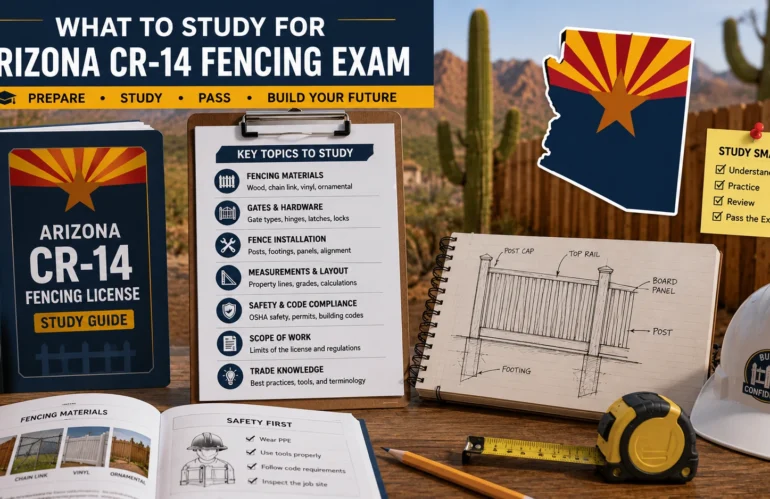
Knowing that you need to take the Arizona CR-14 Fencing examination is one thing. Knowing what to study is where preparation becomes much more practical.
Many candidates begin by searching for a single list of “CR-14 exam topics.” The problem is that fencing is not one narrow skill. A working contractor may deal with posts, panels, gates, measurements, materials, site conditions, repairs, specialized fencing systems, and other construction details during a normal project.
Good preparation brings those subjects together.
The Arizona Registrar of Contractors identifies CR-14 as the Fencing classification. Its classification description covers metal, wood, and cement block fencing, along with specified related work such as automatic gates, fire access strobes, cattle guards, and certain low-voltage U.L.-approved electrical fence protective devices. The classification specifically excludes retaining-wall installation and repair.
That scope gives you a useful starting point.
Instead of studying every construction topic you can find online, concentrate on the knowledge connected to the CR-14 trade.
Quick takeaway: CR-14 preparation should focus on practical fencing knowledge, including materials, layout, posts, installation, gates, specialized systems, measurements, repairs, safety, and classification boundaries. Keep Arizona regulatory preparation separate from the trade-focused material.
What Should You Study for the Arizona CR-14 Trade Exam?
A practical CR-14 study plan should cover the major stages of fencing work.
| Study Area | What to Review |
|---|---|
| Fence layout | Measurements, alignment, spacing, corners, openings and site conditions |
| Posts and support | Post placement, structural support, footing concepts and alignment |
| Metal fencing | Components, connections, installation and repair concepts |
| Wood fencing | Posts, rails, boards, fasteners and installation methods |
| Cement block fencing | Masonry components, alignment and structural concepts |
| Gates | Hardware, support, clearance, alignment and automatic systems |
| Specialized systems | Cattle guards, fire access strobes and qualifying low-voltage devices |
| Calculations | Measurements, spacing, quantities and material estimates |
| Safety | Jobsite, excavation, equipment and material-handling principles |
This is not a substitute for the official examination materials. It is a framework for organizing your preparation around the CR-14 trade.
Start With Fence Layout and Measurements
A fence may look simple after it has been completed.
Before installation, however, someone has to determine where it goes, how long it will be, where the gates belong, how the posts will be spaced, and how the fence will respond to the conditions of the site.
That is why layout and measurement deserve an early place in your study plan.
Think about a commercial property with a long perimeter and two vehicle entrances.
The total property boundary does not necessarily equal the amount of fencing material required.
Gate openings change the fence run.
Corners can affect post requirements.
Grade changes can alter installation.
Different fence systems can use different spacing.
A good estimator or installer needs to recognize these details before ordering materials.
Measurement Questions to Practice
- How much fence is actually being installed?
- Where are the gate openings?
- How many posts are needed?
- How does spacing affect material quantities?
- Where are corners or changes in direction?
- How does the site grade affect the layout?
Do not simply memorize a formula. Learn what the calculation represents.
Fence Posts and Structural Support
Posts are one of the fundamental components of a fence system.
They support the fencing material and transfer loads into the ground or supporting structure.
When studying posts, consider the complete installation rather than one dimension.
Think about the type of fence, post material, spacing, soil conditions, fence height, gate loads, wind exposure, and other project-specific factors.
A fence installed in loose soil may present different challenges from one installed in compact ground.
A large vehicle gate may place different demands on its supporting posts than a small pedestrian gate.
These examples show why trade knowledge involves understanding relationships between components.
Fence Footings and Ground Conditions
The ground beneath a fence can have a major effect on the completed installation.
Before digging, contractors need to consider the site’s physical conditions and applicable requirements.
Excavation also introduces safety considerations.
For study purposes, connect footing questions with three ideas:
- Support
- Stability
- Site conditions
The exact construction method depends on the fence system, soil, design requirements, applicable codes, and project specifications.
When reviewing technical material, avoid assuming that one installation method works for every project.
Metal Fence Installation Topics
Metal fencing is specifically included within the CR-14 classification.
Study the major components that make up a metal fence system and understand how those components work together.
Your review may include posts, rails, panels, connections, fasteners, gates, protective finishes, and repair considerations.
One useful exercise is to look at an existing metal fence and identify each component.
What supports the fence?
What connects the sections?
What holds the panels in place?
Where are the gates?
What components experience the most movement?
How could corrosion or physical damage affect the system?
Turning a real fence into a study diagram can make technical terminology much easier to remember.
Wood Fence Installation Topics
Wood fencing introduces a different collection of components and installation considerations.
Study posts, rails, boards or pickets, fasteners, gates, spacing, alignment, and basic durability considerations.
Pay attention to how the components interact.
A board may look like the most visible part of the fence, but the posts and supporting members determine how the system remains stable.
Fasteners also matter because the connection between materials affects the performance of the completed fence.
Cement Block Fence Concepts
Cement block fencing is another material category specifically included in the CR-14 classification description.
If your background is primarily in wood or metal fencing, give this subject additional attention.
Review the basic terminology associated with block construction and understand concepts such as alignment, foundations, reinforcement, joints, openings, and structural support.
Do not attempt to memorize masonry terminology without understanding what each component does.
When you understand the function, the terminology becomes easier to retain.
Gate Installation and Repair Knowledge
Gates deserve special attention because they are more than openings in a fence.
A properly functioning gate needs adequate support, correct alignment, appropriate hardware, sufficient clearance, and reliable movement.
Automatic gates introduce additional components and operating considerations.
When studying gates, compare different situations rather than learning one generic installation.
| Gate Type | Study Considerations |
|---|---|
| Pedestrian gate | Hinges, alignment, latch, clearance and support |
| Vehicle gate | Greater size, structural support, hardware and movement |
| Automatic gate | Gate structure plus applicable operating and access components |
This comparison helps you recognize why different gate systems require different approaches.
Automatic Gate Systems and CR-14
Automatic gates are expressly identified in the Arizona CR-14 classification description.
For exam preparation, become familiar with the basic relationship between the gate structure and the automatic operating system.
Consider support, alignment, movement, hardware, access controls, and safety features.
At the same time, remember that a fencing classification does not automatically authorize every type of electrical work that might appear on a gate project.
Always evaluate the exact scope against the current Arizona classification requirements.
Cattle Guards as a CR-14 Study Topic
Cattle guards are specifically identified in the CR-14 classification description.
They are designed to help control vehicle access while allowing vehicles to cross an opening without requiring a conventional gate to be opened manually.
When studying cattle guards, think about their relationship with the surrounding fence system, vehicle movement, installation, structural support, and site conditions.
Understanding the purpose of the component makes it easier to remember why it appears within the classification.
Fire Access Strobes and Fencing Systems
Fire access strobes are also included within the current CR-14 classification description.
This is another example of why candidates should study the official classification rather than relying on assumptions about what fencing contractors normally install.
When reviewing this topic, focus on understanding the component, its role in access, and the limits of the CR-14 classification.
Low-Voltage Fence Protective Devices
The CR-14 classification includes certain U.L.-approved low-voltage electrical fence protective devices and identifies specific voltage and wattage limitations. The Arizona ROC classification information currently describes devices below 25 volts and 100 watts.
Numerical limits deserve their own place in your study notes.
Write them down, review them separately, and verify them against current Arizona ROC information rather than relying on an old study sheet.
CR-14 Classification Boundaries You Should Remember
A strong candidate knows where the classification stops.
One of the most important CR-14 limitations is that the classification does not include the installation or repair of retaining walls.
Consider a property with a sloped boundary.
The owner wants a retaining wall along the slope and a fence installed above it.
Because both structures may appear to be part of one project, it can be tempting to treat them as one scope of work.
That would be a mistake.
The fence and retaining wall need to be considered separately according to the applicable contractor classifications.
CR-14 reminder: Study the classification as a boundary, not just a list of permitted services. Knowing what is excluded can be just as important as knowing what is included.
Why Practical Examples Help With CR-14 Study
Technical information becomes easier to remember when you can visualize it on a jobsite.
Instead of memorizing “post spacing,” imagine a contractor laying out a fence line.
Instead of memorizing “gate support,” imagine a large vehicle gate that begins sagging because its support system was inadequate.
Instead of memorizing a classification limitation, imagine a customer asking a fencing contractor to build both a fence and retaining wall.
Real-world situations create context.
And context makes technical information easier to retrieve when you need it.
How to Organize Your CR-14 Study Notes
A simple folder or notebook can be divided into six sections.
- Classification scope and limitations
- Fence materials and components
- Installation and repair concepts
- Gates and specialized systems
- Measurements and calculations
- Questions you repeatedly miss
Keep the last section especially active.
Every time you miss a practice question, add the underlying concept to that list.
After several study sessions, you will have a personalized list of subjects that require the most attention.
Arizona CR-14 Trade Exam Topics: Where to Focus Your Study Time
Once you understand the basic CR-14 scope, the next step is deciding where to spend your study time.
That matters because not every subject deserves equal attention. A candidate with years of fencing experience may already understand basic installation, while someone entering the trade may need to build that foundation from the beginning.
Start with the areas most closely connected to the actual work covered by the classification, then use practice questions to discover where your knowledge is weakest.
| Priority | Study Area | Why It Matters |
|---|---|---|
| High | Classification scope | Helps you distinguish CR-14 work from excluded or unrelated work |
| High | Fencing materials | Forms the foundation of practical trade knowledge |
| High | Posts and structural support | Important to installation and fence stability |
| High | Gates | Includes structural, hardware, and operating considerations |
| Medium | Measurements | Supports estimating and material calculations |
| Medium | Repairs | Tests practical troubleshooting knowledge |
| Medium | Safety | Supports responsible jobsite practices |
The table is a study framework, not an official weighting of examination questions.
Fence Installation Methods: Learn the Process
Rather than memorizing isolated installation facts, walk through a fencing project in sequence.
Start with the site.
Then consider the layout, measurements, excavation, post placement, structural support, fencing material, gates, hardware, and final inspection.
For example, imagine a contractor receives a request to install a long commercial perimeter fence.
The contractor first needs to understand the site and proposed fence line. After determining the layout, the installer can plan post locations and material quantities. The posts then need appropriate support, followed by installation of the selected fence system and any gates.
Every stage creates questions.
What happens if the site changes direction?
What happens at a gate opening?
What happens where the grade changes?
What happens if the soil condition makes excavation difficult?
Thinking through those situations develops the kind of practical reasoning that makes trade-study material easier to understand.
Fence Post Spacing and Layout Questions
Post spacing is an area where candidates should focus on understanding the calculation rather than memorizing one number.
The required spacing can depend on the fence system, materials, design, site conditions, manufacturer requirements, and applicable plans or codes.
For practice, create different layouts and calculate the number of posts needed.
Then change one variable.
Add a gate.
Add a corner.
Change the total fence length.
Ask yourself how the material quantity changes.
This method helps you understand the relationship between layout and quantity.
Example Study Exercise
Scenario: A straight fence run is divided into equal sections, but a gate opening interrupts the line.
Question: Should you simply divide the total property length by the normal spacing and order that number of posts?
Better approach: Account for the actual fence run, openings, terminal conditions, corners, and the requirements of the specific fencing system before calculating the final material quantity.
The important lesson is that real projects rarely behave like perfectly simple diagrams.
Fence Corners, Ends, and Gate Openings
Changes in direction can affect the way a fence is constructed.
A straight run may have one type of post arrangement, while a corner or end condition can require different structural or connection considerations.
Gate openings create another change because the fence is no longer continuous through that area.
When studying, draw simple diagrams.
Draw a straight fence.
Then add a corner.
Then add a gate.
Then add two gates.
Compare the components required in each situation.
This takes only a few minutes but can make abstract layout concepts much easier to visualize.
Fence Installation on Sloped Ground
Not every fence is installed across a flat surface.
Sloped terrain can affect layout, panel positioning, post placement, gates, and the overall appearance of the completed fence.
When studying grade changes, understand the difference between following the slope and maintaining a particular fence profile.
The appropriate method depends on the fence design and project requirements.
A good study question is:
“What changes when the ground changes?”
If your answer covers layout, measurements, post positioning, panel or rail configuration, gate operation, and site conditions, you are thinking about the problem at a practical level.
Fence Repair and Troubleshooting
CR-14 work is not limited to new installations. The classification also includes repair work within its defined scope.
That means troubleshooting is worth incorporating into your preparation.
Imagine a customer reports that a fence section is leaning.
Do not immediately assume that replacing the visible panel will solve the problem.
The underlying issue could involve the post, supporting structure, connection, ground conditions, impact damage, or another component.
Good troubleshooting starts with finding the cause.
Common Troubleshooting Questions
- What component has failed?
- Why did it fail?
- Is the problem isolated or part of a larger issue?
- Does the supporting structure need attention?
- Is the repair within the contractor’s classification?
- Are manufacturer instructions relevant?
This way of thinking can be applied to fences, gates, and other systems covered by the classification.
Automatic Gate Troubleshooting Concepts
Automatic gates introduce another layer of troubleshooting.
If a gate does not operate correctly, the visible symptom does not necessarily identify the underlying problem.
A gate may have alignment problems, structural issues, hardware problems, or issues associated with the operating system.
Study the relationship between the physical gate and the equipment that operates it.
At the same time, be careful about the limits of your contractor classification. A project involving specialized electrical work may require consideration of other licensing requirements.
Fencing Hardware and Connections
Hardware is easy to overlook because individual components may appear small compared with a fence panel or gate.
But hardware is what connects many parts of the system.
Study the purpose of common connection methods and understand why the correct hardware matters.
Consider how hardware can be affected by:
- Load
- Movement
- Weather exposure
- Corrosion
- Improper installation
- Repeated use
A practical question to ask is whether a connection is being used for the purpose it was designed to serve.
Fence Material Selection
Different fencing materials have different characteristics.
When studying material selection, think about the requirements of the project rather than asking which material is universally “best.”
| Material | Possible Project Considerations |
|---|---|
| Metal | Strength, appearance, corrosion exposure, security and maintenance |
| Wood | Appearance, durability, treatment, maintenance and design |
| Cement block | Durability, masonry construction, structural design and appearance |
The appropriate selection depends on the project specifications, environment, design, budget, code requirements, and other factors.
Fence Estimating: From Measurements to Materials
Estimating is another useful skill to practice.
Start with the fence layout.
Determine the actual fence footage.
Account for openings.
Determine the number of posts and sections based on the chosen system.
Then consider gates, hardware, concrete or other supporting materials, labor, equipment, waste, and site-specific conditions.
The exact estimating method will vary by project.
The important skill is learning how to break a project into measurable components.
Why Material Waste Should Be Considered
A perfect mathematical calculation does not always equal the amount of material that should be ordered.
Cutting, damage, irregular dimensions, project changes, and other conditions can create waste.
That does not mean a contractor should simply add an arbitrary percentage to every project.
Instead, understand why waste occurs and determine the appropriate allowance based on the materials and project.
This is especially useful when working with materials that must be cut to specific dimensions.
Commercial Fencing Projects and Site Conditions
Commercial fencing projects can introduce additional complexity.
A project may involve longer fence runs, vehicle access, security requirements, automatic gates, multiple entry points, and coordination with other trades.
Imagine a warehouse property requiring a perimeter fence around a large site.
The contractor may need to account for:
- Vehicle entrances
- Pedestrian access
- Emergency access considerations
- Existing structures
- Grade changes
- Utility conflicts
- Security requirements
- Gate locations
The larger the project becomes, the more important careful planning becomes.
Understanding Fencing and Other Trades
A fencing project can overlap with other construction disciplines.
For example, a project may involve concrete, electrical work, masonry, landscaping, excavation, access control, or retaining structures.
That does not automatically expand the CR-14 license scope.
Always determine which work is actually covered by the classification and whether another appropriately licensed contractor or classification is needed.
This is especially important for projects containing retaining walls because retaining-wall installation and repair are specifically excluded from CR-14.
Safety Topics Worth Reviewing for CR-14
Safety should be treated as part of trade knowledge rather than something to study only because it appears in a checklist.
Fencing work can involve excavation, heavy materials, power tools, vehicles, sharp edges, lifting, concrete, and moving gate components.
Review safe work practices applicable to your projects and equipment.
Particular attention should be given to excavation awareness, personal protective equipment, equipment operation, material handling, traffic exposure, and site-specific hazards.
For official workplace safety requirements, consult the applicable federal, state, and project-specific requirements rather than relying on a generic study summary.
How to Study Technical CR-14 Topics Faster
Use a three-step system:
- Learn: Study the concept and understand the terminology.
- Apply: Connect the concept to a realistic fencing project.
- Test: Answer questions without looking at your notes.
For example, if you are studying fence posts, do not stop after reading about posts.
Imagine a real installation.
Then answer questions about spacing, support, layout, materials, and site conditions.
If you get something wrong, return to the concept instead of memorizing the answer.
Use Your Wrong Answers as a Study Map
Your incorrect answers can tell you more than your correct answers.
Suppose you complete a practice session and discover that most of your mistakes involve gate systems.
That is useful information.
It tells you exactly where to spend your next study session.
| Practice Result | Next Action |
|---|---|
| Strong on materials | Move to mixed questions |
| Weak on calculations | Practice measurements and quantities |
| Weak on gates | Review gate components and installation concepts |
| Weak on scope | Re-read the CR-14 classification description |
| Weak across many areas | Return to fundamentals before increasing test volume |
When Should You Start Taking CR-14 Practice Tests?
Do not wait until the final days before the examination.
Start with smaller practice sessions after completing individual topics.
Once you have reviewed several categories, switch to mixed practice.
Eventually, simulate a more complete testing session so you can evaluate your concentration, pacing, and consistency.
If you want to supplement your study routine with focused question practice, you can work through targeted CR-14 fencing test questions and use your results to decide which subjects deserve another review.
The important part is what you do after the practice session.
Review.
Correct.
Repeat.
Do Not Confuse Practice Scores With Guaranteed Results
A practice score is a measurement of your performance on that particular set of questions.
It is not a guarantee of what will happen on the official examination.
Use practice results as evidence of strengths and weaknesses rather than as a promise of success.
This mindset keeps your preparation realistic and encourages continued study.
Building a Final CR-14 Topic List
As your examination date approaches, create a final list of topics you can explain without looking at your notes.
- CR-14 classification scope
- Classification exclusions
- Metal fencing
- Wood fencing
- Cement block fencing
- Posts and support
- Fence layout
- Measurements
- Gates and gate hardware
- Automatic gate concepts
- Cattle guards
- Fire access strobes
- Qualifying low-voltage fence devices
- Repairs and troubleshooting
- Material calculations
- Jobsite safety
Then compare your list against the current official Arizona classification information and examination resources.
This gives you a much clearer picture of what still needs attention.
How to Create a Final Arizona CR-14 Study Plan
Once you have reviewed the major trade subjects, stop adding new material and start consolidating what you already know.
A final study plan should be built around your weak areas rather than around the amount of material you can read in a day.
For example, if you are comfortable with wood and metal fencing but consistently miss questions involving measurements, gates, or classification limitations, those subjects deserve more attention.
| Study Stage | Recommended Activity |
|---|---|
| Early preparation | Learn the CR-14 scope and core fencing concepts |
| Middle preparation | Study individual trade topics and calculations |
| Active preparation | Use mixed questions to identify weak areas |
| Final review | Focus on recurring mistakes and difficult topics |
| Day before | Light review rather than heavy cramming |
Seven-Day CR-14 Final Review Strategy
If your examination is approaching and you need a structured final review, a seven-day plan can help you stay focused.
Day 1: Classification Scope
Review what CR-14 covers and what it does not cover.
Pay particular attention to the relationship between fencing work and excluded activities such as retaining-wall installation and repair.
Day 2: Materials
Review metal, wood, and cement block fencing.
Compare the components, installation considerations, and terminology associated with each.
Day 3: Posts, Layout, and Measurements
Practice fence-line calculations, post spacing, openings, corners, and material quantities.
Day 4: Gates and Specialized Systems
Review automatic gates, gate hardware, cattle guards, fire access strobes, and qualifying low-voltage fencing devices.
Day 5: Repairs and Troubleshooting
Work through realistic situations involving leaning fences, damaged components, alignment problems, gate issues, and other repair scenarios.
Day 6: Mixed Practice
Complete a mixed practice session without looking at your notes.
Record every question you miss and identify the underlying reason for each mistake.
Day 7: Weak Areas
Do not try to relearn everything.
Review the subjects that repeatedly caused problems during the previous six days.
This final day should reinforce knowledge rather than create additional confusion.
How to Avoid Overstudying the Wrong Topics
One of the biggest problems with online exam preparation is information overload.
You can find thousands of pages about construction, fencing, building codes, business management, estimating, safety, and contractor licensing.
Not all of that information belongs in your CR-14 study plan.
Start with the current Arizona classification and official examination information.
Then build your study material around the actual CR-14 trade.
If a topic does not relate to the classification, the examination requirements, or a legitimate supporting trade concept, ask whether it deserves your study time.
CR-14 Exam Preparation for Beginners
If you are newer to fencing, avoid comparing your preparation schedule with someone who has spent years in the trade.
You may need more time to understand basic terminology, materials, installation processes, and calculations.
Begin with the fundamentals.
Learn how a fence is assembled.
Understand the purpose of each major component.
Study the differences between fencing materials.
Then move into specialized systems and calculations.
Once the technical foundation is strong, introduce more practice questions.
CR-14 Exam Preparation for Experienced Contractors
Experienced fencing professionals should take advantage of what they already know.
If you have installed fences for years, you probably do not need to spend excessive time learning what a post, rail, panel, or gate is.
Instead, test your knowledge.
Use questions to identify areas where your field experience does not translate cleanly into examination terminology.
Spend additional time on Arizona-specific requirements and classification boundaries because those subjects may be less familiar than day-to-day installation work.
What If You Keep Missing the Same CR-14 Questions?
Repeated mistakes are not necessarily bad news.
They are information.
If you keep missing questions about the same subject, your practice sessions are showing you exactly where the problem is.
Use this process:
- Identify the topic.
- Read the question again.
- Determine why your answer was incorrect.
- Review the underlying concept.
- Write a short explanation in your own words.
- Answer a different question about the same subject.
Do not simply memorize the correct option.
The goal is to correct the misunderstanding that caused the mistake.
How to Use a CR-14 Practice Test Effectively
A practice test is most valuable when you use it as a diagnostic tool.
Before starting, create an environment that resembles the conditions in which you expect to take the official examination.
Set aside distractions.
Read each question carefully.
Do not immediately look up an answer when you are uncertain.
After finishing, review your results.
| Practice Outcome | What to Do Next |
|---|---|
| High accuracy with consistent results | Continue mixed review and maintain weak-topic notes |
| Strong trade knowledge but weak regulations | Increase Arizona statutes and rules study |
| Strong regulations but weak trade questions | Increase CR-14 technical review |
| Weak calculations | Practice measurement problems separately |
| Inconsistent results | Slow down and identify recurring mistakes |
If you want more focused repetition while preparing, use a dedicated CR-14 practice test resource to challenge yourself across the fencing topics you have been reviewing.
Again, treat practice performance as feedback rather than a prediction of your official result.
Why Reviewing Incorrect Answers Is So Important
Suppose you answer 80 questions and get 65 correct.
You might look at the score and feel encouraged.
But the 15 incorrect answers may contain your most valuable study information.
Perhaps 8 of them involve gates.
Perhaps 4 involve measurements.
Perhaps 3 involve classification scope.
Now your next study session has a clear direction.
Instead of reading another 100 pages, you can concentrate on three specific weaknesses.
That is what makes diagnostic practice more efficient.
Arizona CR-14 Study Tips for Better Retention
Use short, focused sessions rather than trying to absorb everything in one sitting.
At the end of each session, close your notes and explain the main concepts from memory.
Draw diagrams for fence layouts.
Use real projects as mental examples.
Compare similar materials and systems.
Keep a list of difficult terms.
Write down recurring mistakes.
Return to difficult topics after a gap instead of studying them continuously for hours.
This creates repeated exposure without turning preparation into passive rereading.
Do You Need to Memorize Everything for CR-14?
No study plan should be based on the assumption that every detail has equal importance.
You need to understand the core concepts and recognize important technical details, limitations, terminology, and requirements.
Some information should be memorized, particularly specific limits or classification boundaries that you are expected to know.
Other information is better understood through principles.
For example, knowing how a fence system is assembled is more useful than memorizing a random list of components without understanding their purpose.
CR-14 Exam Day Checklist
Before leaving for the examination, make sure you have reviewed the current testing instructions and any required identification or other materials.
Keep your final review simple.
- Review the CR-14 scope.
- Review important exclusions.
- Review major fencing materials.
- Review gates and specialized systems.
- Review calculations.
- Review your most common practice mistakes.
- Confirm the current examination instructions.
- Give yourself enough time to arrive prepared and calm.
Avoid trying to learn a completely unfamiliar subject immediately before the examination.
Why the CR-14 Classification Matters Beyond the Exam
Passing the examination is an important milestone, but the knowledge has value after test day as well.
A fencing contractor needs to understand the boundaries of the work their business is authorized to perform.
Arizona ROC states that contractors should ensure their classification covers the work they perform and that contractors must be properly licensed before submitting bids. ([roc.az.gov](https://roc.az.gov/license-classifications/)
That makes CR-14 scope knowledge useful when evaluating future projects.
For example, a customer may ask a fencing company to handle fencing, automatic gates, masonry, retaining walls, and other site work as one package.
The contractor should break the project into its individual scopes rather than assuming everything falls under the fencing classification.
How CR-14 Knowledge Can Support Business Growth
A specialized contractor can build a business around a clearly defined service area.
For a fencing company, that can mean developing expertise in commercial fencing, residential fencing, gates, access systems, repairs, and other work within the permitted classification.
Understanding the licensing boundaries can help the business make more informed decisions about which projects to pursue and when another classification or appropriately licensed professional may be necessary.
In other words, licensing knowledge can influence business decisions long after the examination has been completed.
Why Choose CertFellow for Arizona CR-14 Exam Preparation?
Preparing for a specialized contractor examination can be difficult when you have no way to measure how well you are retaining the material.
CertFellow provides a focused practice resource for candidates preparing for the Arizona CR-14 Fencing examination.
The benefit of targeted practice is that it gives you an opportunity to move from reading into active recall.
You can answer questions, identify weak areas, revisit the underlying concepts, and then test yourself again.
That process can be particularly useful for experienced contractors who know the trade but want to become more comfortable with examination-style questions.
It can also help newer candidates determine which subjects need additional study before examination day.
Ready to put your CR-14 knowledge to the test?
Strengthen your preparation with focused questions and use your results to identify the topics that deserve another review.
Frequently Asked Questions About Studying for CR-14
1. What subjects should I study for the Arizona CR-14 Trade Exam?
Focus on the trade knowledge associated with the CR-14 Fencing classification. Useful study areas include metal, wood, and cement block fencing, posts, layout, installation, gates, specialized fencing components, measurements, calculations, repairs, and classification limitations. Always use current official examination information when determining the applicable content.
2. Should I study the Arizona Statutes and Rules Exam separately?
Yes. The Statutes and Rules Exam covers Arizona contractor regulatory knowledge, while the CR-14 Trade Exam focuses on the fencing classification. Treat them as separate study areas so that strong field experience does not cause you to overlook Arizona-specific regulatory preparation.
3. What is the best way to remember CR-14 technical information?
Connect technical information to realistic fencing situations. Use diagrams, calculations, comparison tables, active recall, and practice questions. When you miss a question, review the underlying concept instead of memorizing the correct answer.
4. Is practice testing useful if I already have years of fencing experience?
Yes. Experienced contractors may know the practical work well but still benefit from identifying unfamiliar terminology, calculation mistakes, classification details, or question formats. Practice can show where field experience needs to be supplemented with focused examination preparation.
5. What should I verify before taking the Arizona CR-14 examination?
Verify the current examination requirements, classification information, application procedures, testing instructions, and other licensing details through the Arizona Registrar of Contractors. Requirements and procedures can change, so older study material should not be treated as the final authority.
Final Thoughts: Study the Trade, Not Just the Questions
The best way to prepare for the Arizona CR-14 examination is not to chase an endless collection of practice questions.
Build the knowledge underneath those questions.
Understand the CR-14 scope.
Learn the major fencing materials.
Review posts, layout, measurements, gates, repairs, and specialized systems.
Understand the classification’s limitations.
Separate trade preparation from Arizona regulatory preparation.
Then use practice questions to find the gaps.
If you miss a question, do not treat it as a failure.
Treat it as a study signal.
Go back to the subject.
Understand the reason behind the correct answer.
Try another question.
Repeat the process until the concept becomes familiar.
Most importantly, keep your licensing information current. The Arizona Registrar of Contractors is the appropriate source for official requirements, classification information, application procedures, and regulatory updates.
CR-14 is a specialized fencing classification, and understanding its scope can help you in two different ways: it can make your examination preparation more focused, and it can help you recognize the boundaries of your professional work after licensing.
Prepare with purpose, test your knowledge honestly, and use your weak areas to guide the final stages of your study.