Becoming an escrow officer in Washington involves more than passing a licensing examination. Candidates also need to understand the state’s eligibility requirements, employment or association requirements, application process, documentation, fees, and ongoing licensing responsibilities.
That can make the process confusing for someone entering the escrow industry for the first time.
You may know that an examination is involved, but questions quickly follow: Do you need to work for an escrow company? When should you apply for the license? How long is an exam pass valid? What documents are required? What fees apply? What happens after you receive the license?
These details matter because passing the examination is one step within a larger licensing process.
The Washington State Department of Financial Institutions (DFI) regulates escrow agents and escrow officers in Washington and provides the official licensing, examination, laws, rules, and compliance information used by applicants and licensed professionals. ([dfi.wa.gov](https://dfi.wa.gov/escrow-agents)
Quick answer: A prospective Washington escrow officer generally needs to meet the applicable eligibility requirements, pass the Escrow Officer Examination, be associated with an actively licensed escrow agent, and complete the state licensing application process within the required time period.
What Is a Washington Escrow Officer License?
An escrow officer license authorizes an individual to perform escrow officer activities within the framework established by Washington law and regulation.
Escrow professionals occupy an unusual position in a transaction. They may handle money, documents, instructions, and communications involving multiple parties while remaining subject to specific legal and professional responsibilities.
The job therefore requires more than administrative ability.
An escrow officer needs to understand how transactions are handled, how funds are safeguarded and accounted for, what documentation is required, and what actions are permitted under Washington’s regulatory framework.
Washington DFI explains that escrow officers are licensed individuals associated with licensed escrow agents. The department oversees licensing and regulation under Washington’s escrow laws and administrative rules. ([dfi.wa.gov](https://dfi.wa.gov/escrow-agents/licensing)
For someone considering this career, understanding the licensing process before beginning preparation can save considerable time.
Who Needs an Escrow Officer License in Washington?
The licensing requirement is relevant to individuals who perform escrow officer functions under Washington’s regulated escrow framework.
Washington DFI states that all escrow officers must take and pass the Escrow Officer Examination and then submit an Escrow Officer Application within one year of passing the examination. The applicant must also be associated with an actively licensed escrow agent. ([dfi.wa.gov](https://dfi.wa.gov/escrow-agents/licensing)
This last point is particularly important for people researching the profession from outside the industry.
You should not think of the escrow officer license as a completely independent credential that operates separately from an escrow company. Washington connects the individual escrow officer to an actively licensed escrow agent.
Washington Escrow Officer Requirements at a Glance
| Requirement or Step | What Candidates Should Know |
|---|---|
| Escrow Officer Examination | Candidates must pass the Washington Escrow Officer Examination |
| Application timing | DFI currently requires the application within one year of passing the examination |
| Escrow agent association | The applicant must be associated with an actively licensed escrow agent |
| License application | The applicant must submit the required application and supporting information |
| Fees | Applicable examination and licensing fees must be paid |
| Ongoing compliance | Licensed professionals remain subject to Washington escrow laws and rules |
This table is a planning overview, not a substitute for the current Washington DFI application instructions.
Step 1: Understand the Washington Escrow Regulatory Framework
Before preparing for the examination, become familiar with the regulatory environment in which an escrow officer works.
Washington’s escrow industry is governed by state statutes and administrative rules. Washington DFI provides a dedicated collection of escrow laws and rules for regulated escrow agents and officers. ([dfi.wa.gov](https://dfi.wa.gov/escrow-agents/laws-rules)
You do not need to become a lawyer to understand the framework.
What you do need is a practical understanding of the responsibilities that affect daily escrow operations.
For example, think about:
- Handling and accounting for escrow funds
- Maintaining required transaction records
- Following escrow instructions
- Performing duties within applicable time requirements
- Understanding restrictions on fees and charges
- Maintaining appropriate professional conduct
- Following Washington licensing requirements
These concepts will become much easier to understand when you connect them to actual transaction situations.
Step 2: Prepare for the Washington Escrow Officer Examination
The examination is an important part of the licensing process. If you want to understand the test itself before moving through the licensing steps, our Washington Escrow Officer Exam guide provides a focused overview of the examination and what candidates should know before test day.
.
Washington DFI identifies the Escrow Officer Examination as a required step for individuals seeking an escrow officer license. The department also provides examination resources and information about common compliance problems encountered during escrow examinations. ([dfi.wa.gov](https://dfi.wa.gov/escrow-agents/escrow-examinations-and-resources)
Preparation should therefore include both examination knowledge and practical understanding.
Do not study only general real estate concepts.
Focus on Washington-specific escrow responsibilities and the rules that govern how escrow transactions are handled.
What Should You Learn Before Taking the Exam?
Your study plan should cover areas such as:
- Washington escrow laws and administrative rules
- Licensing terminology
- Escrow transaction procedures
- Trust-account responsibilities
- Fund disbursement
- Account reconciliation
- Recordkeeping
- Fees and charges
- Timely performance of escrow duties
- Professional and compliance responsibilities
These areas should be studied using current official information and applicable educational resources.
Step 3: Pass the Washington Escrow Officer Exam
Once your preparation is complete, you can take the required examination.
Washington DFI currently lists the Escrow Officer Test or Retest fee at $168. The department publishes its current fee schedule separately from the general licensing information. ([dfi.wa.gov](https://dfi.wa.gov/escrow-agents/escrow-agentsofficers-fee-schedule)
Fees are subject to change, so candidates should verify the current amount before registering.
Passing the exam is a significant milestone, but remember that it is not the same thing as completing the entire licensing process.
Step 4: Understand the One-Year Application Window
This is a detail that candidates should not overlook.
Washington DFI currently states that the Escrow Officer Application must be submitted within one year of passing the Escrow Officer Examination. ([dfi.wa.gov](https://dfi.wa.gov/escrow-agents/licensing)
That creates a practical reason to think about your employment and application plans before sitting for the examination.
Imagine passing the exam and then waiting many months before beginning the licensing process. If you are not tracking the deadline, you could create an avoidable administrative problem.
Keep a record of your examination date and review the current DFI instructions so you know what needs to happen next.
Step 5: Become Associated With an Actively Licensed Escrow Agent
Washington’s licensing process also requires the applicant to be associated with an actively licensed escrow agent.
This is an important distinction for career planning.
If you are entering the industry, researching employers and understanding how escrow companies operate can be just as important as studying for the examination.
An escrow agent is the licensed business through which escrow services are provided, while an escrow officer is the individual performing regulated escrow functions within that organization.
Understanding the relationship between these two roles makes the licensing system easier to understand.
Escrow Agent vs. Escrow Officer: What Is the Difference?
| Escrow Agent | Escrow Officer |
|---|---|
| Licensed escrow business or organization | Individual licensed professional |
| Maintains the regulated business operation | Performs escrow officer functions |
| Subject to Washington regulatory requirements | Subject to individual licensing requirements and professional responsibilities |
| Employs or associates escrow officers | Must be associated with an actively licensed escrow agent under the applicable process |
The distinction matters because someone researching an escrow career can easily assume that becoming an escrow officer means opening an escrow business.
Those are different concepts.
What Documents May Be Needed for the Application?
Application documentation depends on the applicant and the current Washington DFI requirements.
Washington’s Escrow Officer Application materials identify information and supporting documentation that applicants may need to provide as part of the licensing process. ([dfi.wa.gov](https://dfi.wa.gov/sites/default/files/forms/eoapp.pdf)
Because application forms can be revised, candidates should download and review the current version rather than relying on an old copy saved on a computer or shared through a discussion forum.
A useful habit is to create an application folder containing:
- Examination result documentation
- Current application forms
- Required identification or supporting documents
- Employment or association information
- Payment information
- Copies of submitted materials
Keeping your records organized can make the application process much less stressful.
How Much Does It Cost to Become a Washington Escrow Officer?
The total cost depends on the fees applicable to your specific licensing situation.
Washington DFI currently lists an Escrow Officer Test or Retest fee of $168. Its fee schedule separately lists the Escrow Officer application review and renewal fee at $179.26. ([dfi.wa.gov](https://dfi.wa.gov/escrow-agents/escrow-agentsofficers-fee-schedule)
These are regulatory fees and may change, so do not treat an old online cost estimate as permanent.
| Potential Cost | Current DFI Listed Amount |
|---|---|
| Escrow Officer Test or Retest | $168 |
| Escrow Officer application review / renewal | $179.26 |
| Study materials | Varies by provider |
| Other personal preparation costs | Varies |
The table is intended as a planning reference only. Verify the current Washington DFI fee schedule before making payment.
Why Washington-Specific Licensing Knowledge Matters
Someone with experience in escrow from another state may assume that most of the licensing process will transfer automatically.
That can be a costly assumption.
Escrow regulation is state-specific. A procedure that is familiar in one state may operate differently in Washington.
For example, a professional may already understand the general principles of escrow funds and closing coordination but still need to learn Washington requirements involving licensing, records, fees, account management, and compliance.
That is why state-specific preparation matters even for experienced professionals.
What Happens After You Become Licensed?
Receiving your license is the beginning of your professional responsibilities, not the end.
Escrow officers work within a regulated environment and must continue following applicable Washington laws and administrative rules.
Washington DFI’s examination resources provide a useful illustration of why ongoing compliance matters. The department identifies issues such as insufficient funds before disbursement, unauthorized fees, missing records, and failure to perform duties in a timely manner among common escrow examination problems. ([dfi.wa.gov](https://dfi.wa.gov/escrow-agents/escrow-examinations-and-resources)
In other words, passing the licensing examination does not mean compliance stops.
It becomes part of the job.
How to Prepare for the Washington Escrow License Application
Passing the Washington Escrow Officer Examination is a major step, but the application stage deserves the same attention to detail.
A common mistake is to treat the application as a simple formality. In reality, applicants need to make sure their information is accurate, supporting documentation is complete, applicable fees are paid, and the licensing requirements have been satisfied.
Washington DFI provides the official application materials and instructions for escrow officer applicants. Because forms and requirements can change, use the current DFI materials when preparing your application rather than relying on an older copy. ([dfi.wa.gov](https://dfi.wa.gov/escrow-agents/licensing)
Before submitting anything, review your application as if someone who knows nothing about your background will be reading it.
Is every section complete?
Are names and dates consistent?
Have you included the required supporting information?
Have you retained a copy of everything you submitted?
Those small steps can prevent unnecessary delays.
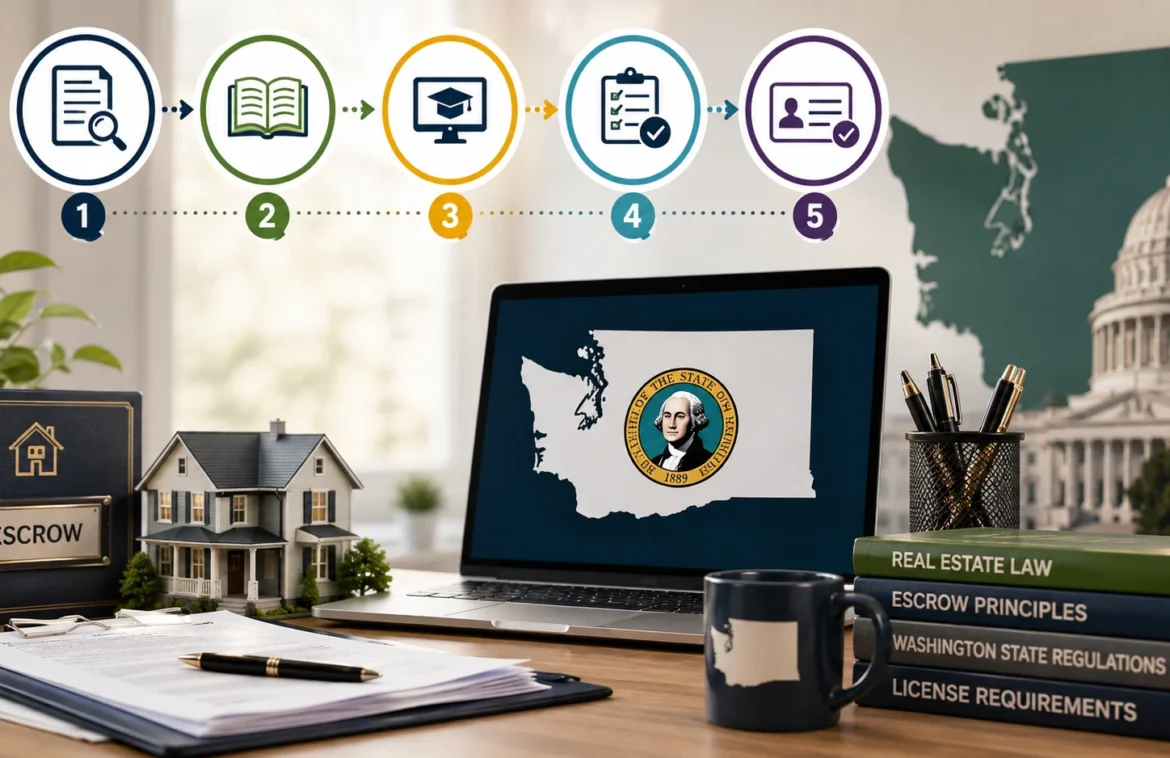
Washington Escrow Officer Licensing Timeline
The licensing process becomes easier to understand when you view it as a sequence rather than a collection of unrelated requirements.
| Stage | What Happens |
|---|---|
| 1. Career planning | Research the role and identify an actively licensed escrow agent |
| 2. Exam preparation | Study Washington-specific escrow laws, rules, and responsibilities |
| 3. Examination | Take and pass the required Escrow Officer Examination |
| 4. Association | Be associated with an actively licensed escrow agent |
| 5. Application | Submit the required Escrow Officer Application and supporting information |
| 6. Review | DFI reviews the application according to the applicable licensing requirements |
| 7. Licensed practice | Continue meeting Washington’s professional and regulatory obligations |
Washington DFI currently states that an applicant must submit the Escrow Officer Application within one year of passing the examination and must be associated with an actively licensed escrow agent. ([dfi.wa.gov](https://dfi.wa.gov/escrow-agents/licensing)
Keep the one-year requirement in mind when planning your transition into the profession.
Finding an Escrow Employer Before Applying
Because Washington connects an escrow officer’s license to an actively licensed escrow agent, employment and career planning should not be left until the final moment.
If you are new to the industry, start researching escrow companies early.
Look for organizations that conduct the types of transactions or provide the types of escrow services that interest you. Learn about their work environment, training expectations, technology, transaction volume, and the responsibilities typically assigned to new escrow professionals.
An interview can also be an opportunity to ask practical questions.
- Will new escrow officers receive structured training?
- What types of transactions does the company handle?
- How are files assigned?
- What software does the office use?
- How does the company handle quality control?
- What continuing education or professional development is encouraged?
You are not simply looking for a job title.
You are looking for an environment where you can learn how to perform the work correctly.
What Does an Entry-Level Escrow Officer Actually Need to Learn?
A newly licensed professional may quickly discover that classroom knowledge and day-to-day transaction management are two different experiences.
In a real escrow office, you may encounter deadlines, incomplete documents, last-minute instructions, questions from transaction participants, accounting issues, and situations that require careful coordination.
The professional who succeeds is not necessarily the person who works the fastest.
It is often the person who develops a reliable process.
Check the file.
Verify the instructions.
Confirm the funds.
Document the activity.
Follow the applicable requirements.
Communicate clearly.
Then move to the next task.
That discipline becomes particularly important in a regulated environment.
Why Escrow Compliance Matters After Licensing
Licensing gives you permission to perform the regulated role, but it does not remove the obligation to comply with Washington law.
Washington DFI conducts examinations of escrow companies and identifies recurring problems involving areas such as trust accounts, unauthorized fees, recordkeeping, and timely performance of escrow duties. ([dfi.wa.gov](https://dfi.wa.gov/escrow-agents/escrow-examinations-and-resources)
That means a good escrow professional should develop compliance habits from the beginning.
Do not wait until an audit or examination to discover that a process is inconsistent.
Learn to recognize potential problems while handling the transaction.
Trust Account Discipline for New Escrow Professionals
Money management is one area where accuracy matters enormously.
Escrow funds belong to transaction parties and must be handled according to applicable requirements.
Washington DFI identifies insufficient funds before disbursement as a common escrow examination problem. ([dfi.wa.gov](https://dfi.wa.gov/escrow-agents/escrow-examinations-and-resources)
For someone entering the profession, this illustrates why “close enough” is not an acceptable standard for escrow accounting.
Suppose a transaction is scheduled to close and the file appears complete. The parties are ready. The closing team is under pressure.
But the necessary funds have not actually been received in the manner required for disbursement.
The fact that everyone wants to close does not change the underlying responsibility.
Professional discipline means recognizing the problem and following the applicable procedure.
Record keeping Habits to Develop Early
Good documentation should become a routine rather than something you do only when you think someone may review the file.
Washington DFI specifically identifies failures involving required records among common examination issues. ([dfi.wa.gov](https://dfi.wa.gov/escrow-agents/escrow-examinations-and-resources)
A strong record keeping process helps answer basic questions later:
- What instruction was received?
- When was it received?
- What action was taken?
- What funds were received?
- What funds were disbursed?
- What documentation supports the transaction?
Good records protect the transaction and help the organization demonstrate that the file was handled appropriately.
Understanding Escrow Fees and Charges
Fees can become another area of regulatory risk.
Washington DFI lists unauthorized fees among common examination problems and gives examples involving certain post-closing and reconveyance-related charges. ([dfi.wa.gov](https://dfi.wa.gov/escrow-agents/escrow-examinations-and-resources)
A new professional should therefore develop the habit of verifying charges instead of assuming that a fee is permissible because it appears in another company’s fee schedule.
Industry custom is not a substitute for Washington requirements.
When you encounter an unfamiliar charge, determine the applicable authority and conditions before treating it as routine.
Washington Escrow Officer Renewal and Ongoing Responsibilities
Getting the initial license is only the beginning of a professional licensing relationship.
Escrow officers need to remain aware of renewal requirements, applicable fees, regulatory changes, and continuing professional obligations.
Washington DFI publishes current licensing and fee information for escrow professionals. ([dfi.wa.gov](https://dfi.wa.gov/escrow-agents/escrow-agentsofficers-fee-schedule)
Do not rely on a calendar reminder from someone else or assume that a license will remain current automatically.
Maintain your own record of important dates and check the regulator’s current information when renewal approaches.
What Can Make the Washington Escrow Licensing Process Easier?
Organization.
It sounds simple, but it can make a significant difference.
Create a personal licensing checklist and keep your examination records, application documents, payment receipts, employment information, and other relevant materials together.
Then separate your documents into two categories:
| Licensing Documents | Professional Development |
|---|---|
| Exam result | Study notes |
| License application | Regulatory references |
| Supporting documents | Compliance resources |
| Payment records | Training materials |
| License information | Professional development records |
Keeping these categories separate makes it easier to locate what you need when a deadline arrives.
How to Avoid Delays in the Licensing Process
Many administrative problems are preventable.
Do Not Wait Until the Last Minute
If your exam has been passed, start reviewing the application requirements rather than putting the entire process aside.
Use the Current Application
Always obtain the current Washington DFI form and instructions.
Check Every Field
An incomplete application can create unnecessary back-and-forth.
Keep Copies
Save a copy of your submitted application and supporting materials for your own records.
Track Deadlines
Record the date you passed the examination and the applicable application deadline.
Confirm Your Association
Make sure your relationship with the applicable escrow agent satisfies the current Washington requirements before submitting the application.
A Realistic Example of Licensing Preparation
Consider someone named Daniel who has worked in a real estate office for several years and wants to transition into escrow.
He studies for the examination, passes it, and assumes the hard part is over.
Instead of immediately organizing the next steps, he waits several months while researching different career opportunities.
Eventually, he finds an escrow company interested in working with him but discovers that he needs to carefully coordinate the remaining licensing process within the applicable timeframe.
A more organized approach would have been to begin planning before the examination was taken.
Daniel could have researched licensed escrow agents, prepared his documentation, recorded his exam date, and reviewed the application requirements immediately after passing.
The lesson is not that everyone must follow Daniel’s exact timeline.
The lesson is that licensing is easier when you treat it as a project with milestones rather than a form you will complete someday.
How Exam Preparation Can Support Your Licensing Career
The knowledge you develop while preparing for the examination can become the foundation for your first professional responsibilities.
When you study Washington escrow regulations, do not ask only whether a fact could appear on the exam.
Ask whether the rule could affect a transaction.
When you study trust accounts, think about why accurate accounting matters.
When you study record keeping, think about what an examiner or another professional would need to understand from the file.
When you study fees, think about why authorization matters.
This approach gives your study time a second purpose.
You are not only preparing to pass a test.
You are developing habits that can support responsible professional work.
Preparing for the Transition From Candidate to Licensed Professional
The mindset changes once you enter the profession.
As a candidate, your question is often:
“What do I need to know to pass?”
As a professional, the question becomes:
“What do I need to do correctly?”
That distinction is important.
A test may have one correct answer.
A real transaction can involve several moving parts, competing deadlines, incomplete information, and communication between multiple parties.
The professional habit is to slow down when something is unclear, verify the applicable requirement, document appropriately, and avoid making assumptions.
That is a valuable mindset for anyone entering Washington’s escrow industry.