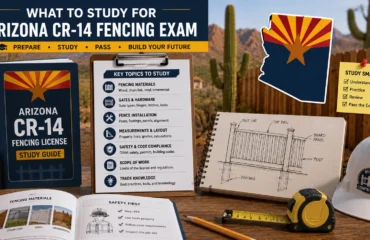
If you are preparing for the Arizona CR-14 contractor examination, the first thing to understand is exactly what the classification covers.
CR-14 is Arizona’s Fencing classification. It is not a general construction license and it is not simply a test about installing fence panels. The Arizona Registrar of Contractors (AZ ROC) defines CR-14 as a specialty commercial classification covering specific fencing-related work, including metal, wood, and cement block fencing, automatic gates, fire access strobes, cattle guards, and certain low-voltage electrical fence protective devices.
The classification also has an important limitation: CR-14 does not authorize the licensee to install or repair retaining walls.
That distinction matters when you are studying because the best preparation begins with understanding the boundaries of the classification rather than memorizing unrelated construction information.
Arizona’s contractor licensing system also requires applicants to meet qualifying-party requirements and pass the examinations applicable to their classification unless an approved waiver applies. AZ ROC currently lists CR-14 with a three-year experience requirement and both the Statutes & Rules Exam (SRE) and Trade examination.
Quick takeaway: CR-14 is Arizona’s commercial fencing classification. A strong preparation plan should cover both Arizona contractor regulations and the practical knowledge associated with fencing work allowed under the classification.
What Is the Arizona CR-14 Contractor License?
The Arizona CR-14 license classification is designed for contractors performing qualifying fencing work in the commercial contracting category.
According to the Arizona Registrar of Contractors, CR-14 allows a licensee to install and repair:
- Metal fencing
- Wood fencing
- Cement block fencing
- Automatic gates
- Fire access strobes
- Cattle guards
- Certain low-voltage U.L.-approved electrical fence protective devices
The AZ ROC classification also places a limitation on the scope: CR-14 does not allow the licensee to install or repair retaining walls.
This scope is one of the first things a candidate should understand.
Why?
Because contractor licensing is closely connected to the type of work a business is legally authorized to perform. Arizona ROC advises that contractors must be properly licensed before submitting bids, and the classification on the license needs to match the work being performed.
What Does CR-14 Fencing Cover?
The easiest way to understand the classification is to divide it into the major types of work it covers.
| CR-14 Area | Examples |
|---|---|
| Fencing | Metal, wood, and cement block fencing |
| Automatic gates | Installation and repair of qualifying automatic gate systems |
| Security-related equipment | Fire access strobes |
| Property access | Cattle guards |
| Low-voltage fencing devices | Certain U.L.-approved devices below the specified voltage and wattage limits |
This list should be treated as a classification overview rather than an instruction to assume that every project containing one of these components automatically falls within CR-14.
The exact scope of a project should always be evaluated against the current Arizona classification requirements and applicable regulations.
What Work Is Not Covered by Arizona CR-14?
Knowing what a license allows is only half of understanding a classification.
You also need to know its boundaries.
For CR-14, one especially important limitation is retaining walls. The Arizona ROC classification specifically states that CR-14 does not allow the licensee to install or repair retaining walls.
This creates a useful study habit.
Whenever you learn a contractor classification, create two lists:
- Authorized work
- Excluded or restricted work
That approach can make classification questions much easier to understand.
A Simple Example
Imagine a commercial property owner wants a new perimeter fence and also needs a retaining wall constructed along a sloped portion of the property.
The two projects may appear related because they involve the same property and could occur at approximately the same time.
That does not automatically mean the same license classification covers both activities.
The fence work may fall within CR-14, while the retaining-wall work is specifically outside the CR-14 scope.
This is exactly the kind of distinction that makes classification knowledge important.
Arizona CR-14 Experience Requirement
The Arizona Registrar of Contractors’ classification requirements currently list three years of qualifying experience for CR-14 Fencing. The experience must satisfy the applicable qualifying-party requirements.
Arizona does not treat the qualifying party as someone who merely holds a certificate on paper.
The person serving as the qualifying party must have the necessary experience, knowledge, and skills for the classification.
AZ ROC explains that a business seeking a contractor license must have a regularly employed person with the necessary experience, knowledge, and skills who serves as the qualifying party.
That makes the experience requirement more meaningful than simply counting years.
Your experience needs to relate to the work covered by the classification.
Who Is the Qualifying Party for an Arizona Contractor License?
The qualifying party is an important part of Arizona’s contractor licensing system.
A contractor business can take different legal forms, including a sole proprietorship, partnership, limited liability company, or corporation. Arizona ROC states that the business must have a regularly employed person with the necessary experience, knowledge, and skills who serves as the qualifying party.
The qualifying party helps demonstrate that the business has the technical knowledge and experience necessary for the classification it is seeking.
For someone preparing for CR-14, this means the licensing process is not simply about passing a test.
Experience, examination, business requirements, and documentation all fit into the larger application process.
Which Exams Are Required for Arizona CR-14?
This is one of the most important questions for candidates.
The Arizona Registrar of Contractors’ current classification requirements list SRE and Trade examinations for CR-14. The SRE refers to the Arizona Statutes and Rules Exam, while the Trade exam evaluates knowledge related to the specific classification.
Arizona ROC’s application guidance explains that the qualifying party must pass the required examinations by at least 70 percent. The agency also states that the qualifying party must complete the Arizona Statutes and Rules Training Course and Exam and take the applicable trade examination unless eligible for a waiver.
| Exam | Purpose |
|---|---|
| Arizona Statutes & Rules Exam (SRE) | Tests knowledge of Arizona contractor statutes and rules |
| CR-14 Trade Exam | Tests knowledge relevant to the fencing classification |
This distinction should shape your study strategy.
You are preparing for two different knowledge areas rather than one large test with one subject.
What Is the Arizona Statutes and Rules Exam?
The SRE is the Arizona-specific regulatory component of the contractor licensing process.
Arizona ROC describes the SRE as a computer-based, open-book training course and examination offered online through GMetrix.
Because it focuses on Arizona statutes and rules, candidates should not treat it as a generic construction law examination.
The important word is Arizona.
You need to understand the state’s contractor licensing framework, regulatory expectations, and rules that affect licensed contracting businesses.
What Is the CR-14 Trade Exam?
The trade examination is the classification-specific part of the licensing process.
For CR-14, that means preparing for knowledge associated with fencing work covered by the Arizona classification.
Think about the difference this way:
SRE: How does Arizona regulate contractors?
CR-14 Trade: Does the qualifying party understand the technical and practical knowledge associated with the fencing classification?
Both matter.
A candidate with strong field experience may be comfortable with fencing construction but still need dedicated preparation for Arizona statutes and rules.
Likewise, someone who understands contractor regulations may still need to strengthen technical fencing knowledge.
Why CR-14 Candidates Should Study the Classification Scope First
One of the easiest ways to waste study time is to learn material that does not belong to the classification.
CR-14 is specific.
It is not a license for every type of outdoor construction.
It is not automatically a license for every type of wall, gate, or property improvement.
It is a defined classification with specific permitted work and limitations.
Start your preparation by reading the current classification description and making your own scope checklist.
For each item, ask:
- What type of work is included?
- What materials are specifically identified?
- What related equipment is included?
- Are there voltage or wattage limits?
- What work is expressly excluded?
- What related construction might require another classification?
This turns the classification description into a practical study tool.
CR-14 Fencing Materials You Should Be Familiar With
Because the classification includes multiple fencing materials, candidates should be comfortable with the terminology associated with each.
Metal Fencing
Metal fencing can involve different materials, fabrication methods, fastening systems, posts, gates, and protective finishes.
Study the terminology used in the trade and understand how different fencing systems are assembled and maintained.
Wood Fencing
Wood fencing brings different considerations involving posts, rails, boards, fasteners, layout, spacing, durability, and installation practices.
Cement Block Fencing
Cement block fencing involves masonry-related construction concepts that differ from a simple wood or metal fence.
The goal is not to memorize isolated construction vocabulary. Understand how the components fit together and why the installation process requires particular materials and methods.
Automatic Gates and CR-14
Automatic gates are specifically included within the CR-14 classification description.
That means candidates should not treat gate work as an unrelated subject.
Study the relationship between fencing and access systems, including the components and practical considerations relevant to installation and repair.
At the same time, pay attention to the boundaries between fencing work and other regulated specialties.
If a project involves electrical systems or other work outside the CR-14 classification, do not assume the fencing license automatically authorizes everything connected to the project.
Low-Voltage Fencing Devices and Classification Limits
The CR-14 description also addresses certain low-voltage U.L.-approved electrical fence protective devices and specifies limits of less than 25 volts and 100 watts.
This is a good example of why candidates should read classification descriptions carefully.
A question involving electrical equipment may appear to be about fencing, but the specific technical limits can determine whether the work fits within the classification.
When studying, highlight numerical limits and exclusions.
Those details are easy to overlook during casual reading but can be important when evaluating the boundaries of a license classification.
Why Classification Knowledge Matters Before You Bid a Project
Arizona ROC states that contractors must be properly licensed before submitting bids. The agency also advises property owners to make sure the contractor’s license classification allows for the work listed in the contract.
This makes classification knowledge important outside the examination room.
Imagine a fencing contractor receives a large commercial project involving perimeter fencing, automated gates, a retaining wall, and additional site improvements.
The project may look like one package to the customer.
From a licensing perspective, however, the individual components need to be evaluated according to the applicable classifications.
That is why understanding scope is a professional responsibility as well as an examination subject.
A Practical CR-14 Study Framework
A simple preparation plan can divide the material into four areas:
| Study Area | What to Focus On |
|---|---|
| Classification scope | Authorized fencing work, included systems, limitations, and exclusions |
| Trade knowledge | Materials, installation concepts, repair, gates, and practical fencing knowledge |
| Arizona regulations | Contractor statutes, rules, licensing responsibilities, and compliance |
| Question practice | Applying knowledge to unfamiliar scenarios and identifying weak areas |
Do not try to master everything in one sitting.
Build the foundation first.
Then practice applying it.
Arizona CR-14 Trade Exam: What Knowledge Should You Build?
The CR-14 Trade Exam should be approached as a test of practical fencing knowledge rather than a simple vocabulary exercise.
If you have field experience, you may already recognize many of the materials, tools, installation methods, and jobsite situations involved in fencing. The challenge is turning that experience into organized exam knowledge.
Start by thinking about a fencing project from beginning to end.
A contractor needs to understand the site, measurements, materials, layout, posts, foundations, panels, gates, hardware, installation methods, safety considerations, and repair procedures. Different fencing materials also create different construction requirements.
Studying the trade as a complete process makes isolated facts easier to remember.
Fencing Layout and Site Preparation
Before a fence is installed, the site needs to be evaluated and prepared.
Measurements, property conditions, grade changes, access, existing structures, utilities, and the intended fence layout can all influence the installation.
A mistake at the beginning of the project can create problems throughout the entire fence line.
Imagine a contractor begins installing posts without carefully confirming the planned layout. Several posts are installed before a problem with the property line or site condition becomes apparent.
Correcting the mistake may require removing materials, changing spacing, and repeating work that could have been avoided with better planning.
That is why site preparation should be treated as part of the trade knowledge rather than an administrative step.
Study Questions for Site Preparation
- How should a fence line be planned before installation?
- What site conditions can affect post placement?
- Why are accurate measurements important?
- How can changes in grade affect fence installation?
- What should be considered before excavation?
Use questions like these to test whether you understand the reason behind each procedure.
Fence Posts, Footings, and Structural Support
Posts provide the structural support for many fencing systems.
The strength and durability of a completed fence depend heavily on how the posts are positioned, supported, aligned, and connected to the rest of the system.
When studying posts, do not focus only on dimensions.
Think about the entire load path.
How is the fence supported? How are forces transferred into the ground? What happens when wind, impact, gate movement, or other loads act on the structure?
Different soil conditions, fence heights, materials, and site characteristics can influence construction decisions.
The exact requirements for a particular installation should always be determined from applicable plans, codes, manufacturer instructions, and project requirements.
Metal Fencing Knowledge for CR-14 Candidates
Metal fencing can involve several different systems and construction methods.
A candidate preparing for CR-14 should be comfortable with the terminology surrounding metal fence components, posts, rails, panels, fasteners, gates, connections, and protective finishes.
One useful study technique is to take a completed fence and mentally work backward.
What components make up the system?
How are those components connected?
Which components provide structural support?
Which components provide security or access control?
Which components protect the installation from environmental exposure?
This type of thinking helps turn field experience into organized exam preparation.
Wood Fencing: Components and Installation Concepts
Wood fencing introduces a different group of materials and construction considerations.
Depending on the design, a wood fence may include posts, rails, boards or pickets, fasteners, gates, and other supporting components.
The layout must be consistent, the structural members need adequate support, and the materials need to be selected and installed appropriately for the project.
Pay particular attention to the relationship between the individual components.
A fence panel is only one part of the system. The posts and supporting members determine how that panel is held in position, while hardware connects the components together.
When reviewing wood fencing, ask yourself what could happen if one part of the system is improperly installed.
Cement Block Fencing and Masonry Concepts
Cement block fencing is another area specifically identified within the CR-14 classification.
Because masonry construction differs substantially from wood or metal fencing, candidates should understand the terminology and basic construction principles associated with block fence systems.
Think about foundation requirements, alignment, reinforcement, joints, openings, gates, and the relationship between the wall or fence system and the supporting structure.
Do not assume that experience with wood or chain-link fencing automatically provides enough knowledge for masonry-related questions.
Study each material category separately before combining them during mixed practice.
Automatic Gates and Fence Access Systems
Automatic gates are specifically included in the Arizona CR-14 classification description, making them an important part of classification awareness.
Gate systems introduce moving components and additional hardware that require careful installation and maintenance.
When preparing, become familiar with the major components and the way an automatic gate integrates with a fencing system.
Think about:
- Gate posts and structural support
- Hinges and hardware
- Gate alignment
- Movement and clearance
- Access-control components
- Safety considerations
- Maintenance and repair
At the same time, remember that not every electrical or access-control task automatically falls within the CR-14 classification. The specific scope of work needs to be evaluated against Arizona’s current licensing requirements.
Fire Access Strobes and CR-14 Scope
Fire access strobes are also identified within the CR-14 classification description. ([roc.az.gov](https://roc.az.gov/license-classifications?utm_source=chatgpt.com))
This is a good example of why candidates should study the actual classification description instead of relying on assumptions about what a “fencing contractor” normally does.
When reviewing this subject, focus on understanding why the component is included and where the boundaries of the classification may apply.
If a project includes additional fire protection, electrical, or specialty work beyond the CR-14 scope, verify whether another classification or appropriately licensed specialty contractor is required.
Cattle Guards and Commercial Fencing Projects
Cattle guards are another component specifically included within the CR-14 description.
For commercial fencing candidates, it is useful to understand how cattle guards function as part of a controlled-access system and how they relate to fencing and vehicle movement.
A commercial fencing project can involve more than a straight fence line.
It may include vehicle entrances, pedestrian gates, automatic gates, security features, or specialized access points.
That is why studying individual components in isolation is less useful than understanding how they function together.
Understanding the Difference Between Fencing and Retaining Walls
This distinction deserves special attention.
The Arizona Registrar of Contractors specifically states that the CR-14 Fencing classification does not include the installation or repair of retaining walls.
A retaining wall and a fence can appear together on the same property, especially on sloped sites, but they serve different structural purposes.
Consider a commercial property with a sloping boundary.
The owner wants a retaining structure to hold back soil and a fence installed above it.
The fact that both components are physically connected does not automatically mean they fall under one contractor classification.
This is exactly why scope limitations should be memorized and understood.
CR-14 scope reminder: Fencing work may be within the classification, while retaining-wall installation or repair is specifically excluded. Always verify the current Arizona classification requirements before accepting or bidding work.
Low-Voltage Electrical Fence Devices
The CR-14 classification description also addresses certain U.L.-approved low-voltage electrical fence protective devices and identifies specific limits for that work. The current Arizona classification information specifies less than 25 volts and 100 watts.
Numerical limitations like these deserve special attention during study.
They can be easy to skim past when reading a classification description, yet they define the boundary of what is included.
Create a separate section in your notes for:
- Voltage limits
- Wattage limits
- Approval requirements
- Equipment terminology
- Classification boundaries
Do not rely on memory alone for technical limits. Verify them against the current Arizona ROC classification information.
Arizona CR-14 Estimating and Material Planning
Fencing contractors also need practical estimating knowledge.
A project estimate may involve fence length, materials, posts, gates, hardware, labor, equipment, site conditions, and other project-specific costs.
The purpose of studying estimating is not simply to memorize formulas.
Understand how an accurate estimate is built.
Imagine a contractor estimates a commercial fence based only on the total linear footage.
Later, the contractor discovers that the project contains multiple gates, difficult excavation conditions, grade changes, additional posts, and other installation challenges.
The original estimate may no longer reflect the actual work required.
This is why careful site evaluation and material planning are essential parts of successful fencing work.
Fence Measurement and Material Calculations
Measurement questions become much easier when you understand what the calculation is actually trying to determine.
Depending on the project, you may need to think about linear footage, post spacing, panel quantities, gate openings, material waste, or other project-specific measurements.
For practice, create simple hypothetical projects.
Example: A straight fence run contains a specified number of linear feet and uses a planned post spacing. Instead of memorizing a single answer, determine how many posts are needed, account for terminal conditions, and consider whether gates or corners change the layout.
The goal is to understand the calculation process so that a different set of numbers does not throw you off.
Fence Gates: What Should You Study?
Gates deserve separate attention because they introduce additional structural and operational considerations.
A gate needs appropriate support, alignment, hardware, clearance, and movement.
Larger or automated gates can introduce additional loads and operating considerations.
During study, compare a standard pedestrian gate with a larger vehicle gate.
Ask what changes.
- Structural support
- Hardware
- Clearance
- Alignment
- Operating forces
- Access requirements
- Maintenance considerations
Thinking comparatively is a useful way to prepare for questions that present unfamiliar project situations.
Jobsite Safety for Fencing Contractors
Fencing work can involve excavation, power tools, heavy materials, moving equipment, sharp components, vehicles, and other jobsite hazards.
Safety should therefore be part of your professional preparation even when the immediate focus is the trade examination.
Review the safety requirements that apply to your work, equipment, employees, and jobsite conditions.
Pay attention to excavation-related hazards, personal protective equipment, tool safety, material handling, traffic exposure, and other risks relevant to the specific project.
When preparing for an examination, distinguish between general safety principles and the specific requirements established by applicable laws, codes, standards, or project documents.
Why Codes and Manufacturer Instructions Matter
A professional installation is not based on a single source of information.
Depending on the project, contractors may need to consider applicable building codes, local requirements, project specifications, approved plans, manufacturer instructions, and other governing documents.
That is particularly important when installing specialized equipment such as automatic gates or low-voltage devices.
If a manufacturer specifies an installation method, ignoring those instructions can create performance and warranty problems even if the fence itself appears properly installed.
For exam preparation, develop the habit of identifying which source controls a particular technical decision.
How to Turn Field Experience Into Exam Knowledge
Experienced fencing professionals sometimes make the mistake of assuming that years on the job automatically translate into examination readiness.
Experience is valuable, but an examination may require you to recognize concepts in a different format.
Take something you already know from the field and explain it step by step.
For example:
- How would you plan the fence line?
- How would you determine the appropriate layout?
- How would you prepare the site?
- How would you install and support the posts?
- How would you attach the fencing material?
- How would you install the gate?
- What safety considerations apply?
- What documentation or project requirements must be followed?
If you can explain the process clearly, you are doing more than memorizing terminology.
You are organizing your professional knowledge.
How Practice Questions Can Improve CR-14 Preparation
After studying a topic, test yourself before moving on.
For example, after reviewing automatic gates, answer several questions related to gate components and installation concepts. Then move to another topic and later return to gates through mixed practice.
This helps reveal whether you genuinely understand the material or simply remember what you just read.
If you want an additional resource for this stage, you can work through Arizona CR-14 fencing practice questions to reinforce your review and identify areas where another study session may be useful.
Review incorrect answers carefully. Ask what caused the mistake.
- Did you misunderstand the concept?
- Did you overlook a detail?
- Did you confuse two similar terms?
- Did you make a calculation error?
- Did you misread the question?
Each type of mistake requires a different correction.
A Better Way to Review Incorrect Answers
| Mistake Type | Better Response |
|---|---|
| Knowledge gap | Return to the relevant study material |
| Calculation error | Repeat the calculation step by step |
| Terminology confusion | Compare the two terms directly |
| Missed detail | Practice slower question reading |
| Guessing | Strengthen the underlying concept |
This turns practice into a learning process instead of a simple score generator.
How to Prepare for the Arizona CR-14 Exam
A good CR-14 study plan should not depend on last-minute memorization.
Fencing is a practical trade, and the examination can require you to move between technical knowledge, classification boundaries, calculations, and Arizona contractor requirements.
The most effective approach is to divide preparation into manageable sections and gradually combine them.
| Preparation Phase | Main Objective |
|---|---|
| Week 1 | Understand CR-14 scope and classification boundaries |
| Week 2 | Review fencing materials, components, installation concepts, and trade terminology |
| Week 3 | Study Arizona contractor statutes, rules, and licensing responsibilities |
| Week 4 | Complete mixed practice and concentrate on weak subjects |
You can adjust the timeline according to your experience and examination date. Someone with years of fencing experience may need less time on basic trade concepts but more time reviewing Arizona-specific regulations.
Start With the Arizona CR-14 Classification Scope
Before diving into technical details, make sure you understand what CR-14 actually covers.
The Arizona Registrar of Contractors identifies CR-14 as the Fencing classification and describes work involving metal, wood, and cement block fencing, automatic gates, fire access strobes, cattle guards, and certain low-voltage electrical fence protective devices. Retaining walls are specifically excluded.
Write these categories down.
Then create a second list for exclusions and limitations.
This simple exercise can prevent you from spending hours studying subjects that fall outside the classification.
Build a Separate SRE Study Routine
The Arizona Statutes and Rules Exam deserves its own study schedule.
Do not assume that strong fencing experience will automatically prepare you for the regulatory portion.
The SRE focuses on Arizona contractor statutes and rules, so your preparation should include the official materials applicable to the examination.
Arizona ROC currently provides information about the Statutes and Rules Training Course and Exam through its contractor licensing resources. ([roc.az.gov](https://roc.az.gov/applying-for-a-license/)
Study the regulatory material in short sessions and return to difficult sections more than once.
The objective is to understand how Arizona regulates contractors, not simply to remember isolated phrases.
Use Active Recall Instead of Repeated Reading
Reading the same material several times can create a false feeling of familiarity.
Active recall is different.
Close the book or study material and try to explain the concept from memory.
For example:
- What does CR-14 cover?
- What work is excluded?
- How many years of experience are currently listed?
- Which examinations apply?
- What fencing materials are identified?
- What specialized systems are included?
- What numerical limits apply to certain low-voltage devices?
If you cannot answer, return to the source and review the topic again.
This method quickly reveals what you actually know.
CR-14 Exam Mistakes That Can Hurt Your Preparation
Studying Every Construction Topic You Can Find
More information is not always better.
CR-14 is a defined classification. Concentrate on the knowledge relevant to fencing and the applicable Arizona contractor requirements.
Ignoring Classification Limitations
Knowing what the license covers is not enough. You also need to recognize what falls outside the classification.
The retaining-wall exclusion is an excellent example.
Preparing Only for the Trade Examination
CR-14 candidates should pay attention to both the trade examination and the Arizona Statutes and Rules Exam when both are required for their licensing situation.
Relying Entirely on Field Experience
Practical experience is valuable, but examination questions may present familiar concepts in unfamiliar ways.
Memorizing Answers Without Understanding Them
If you remember that an answer is “B” but do not understand why, a slightly different question can expose the weakness.
Ignoring Official Sources
Third-party study materials can help explain concepts, but Arizona ROC should be the reference point for current licensing requirements and classification information.
How to Handle Difficult CR-14 Questions
When you encounter a difficult question, do not immediately guess.
First identify what the question is actually testing.
Is it asking about:
- Classification scope?
- Materials?
- Installation?
- Measurement?
- Equipment?
- Safety?
- Arizona licensing rules?
- A limitation or exception?
Once you identify the category, eliminate answers that clearly fall outside it.
Then compare the remaining choices against the underlying rule or trade principle.
This is much more reliable than choosing the answer that simply “sounds right.”
Why CR-14 Experience Can Be an Advantage
If you already work in fencing, your field experience gives you an important foundation.
You have probably seen real examples of posts, gates, panels, hardware, layouts, repairs, and site conditions.
Use that experience when studying.
Whenever you learn a technical concept, connect it to something you have actually encountered.
If you are studying gate alignment, picture a gate you have installed.
If you are reviewing post support, think about how different site conditions affected your previous projects.
If you are learning a classification limitation, imagine a real project where that boundary could matter.
Connecting abstract information to experience makes it easier to remember.
Why CR-14 Matters for Arizona Fencing Contractors
A contractor classification is more than a label on a license.
It helps define the type of work a contractor is authorized to perform.
Arizona ROC states that contractors must be properly licensed before submitting bids and that the classification needs to cover the work being performed. ([roc.az.gov](https://roc.az.gov/license-classifications/)
For a fencing business, that makes classification knowledge commercially important.
Imagine a contractor is approached about a large commercial property improvement project.
The project includes perimeter fencing, automated gates, a cattle guard, and a retaining wall.
The contractor may have extensive experience installing fences, but that does not mean every component automatically falls under CR-14.
Understanding the classification before submitting a bid can help the business identify which portions of the project fit within its license and which may require another appropriately licensed contractor or classification.
CR-14 and the Arizona Construction Industry
Arizona’s construction industry includes residential and commercial contractors operating across many specialized classifications.
Specialty classifications allow contractors to demonstrate expertise in defined areas rather than treating every construction activity as interchangeable.
For fencing professionals, CR-14 provides a defined path for qualifying and performing the work covered by the classification.
That can be particularly useful for contractors who want to build a business around fencing, gates, and related systems instead of taking on unrelated construction work.
How to Use Practice Tests During CR-14 Preparation
Practice tests are most useful when they are treated as diagnostic tools.
Do not take a practice test, look at the score, and immediately move on.
Review the questions you missed.
Separate them into categories.
| Result | What It May Mean |
|---|---|
| Missed several scope questions | Review CR-14 classification boundaries |
| Missed technical questions | Review fencing materials and installation concepts |
| Missed calculation questions | Practice measurements and material calculations |
| Missed regulatory questions | Review Arizona statutes and rules |
| Changed correct answers | Work on confidence and careful question reading |
The goal is to turn each incorrect answer into another learning opportunity.
Why Choose CertFellow for Arizona CR-14 Preparation?
Preparing for a contractor examination can become frustrating when you do not know whether you are actually ready.
CertFellow provides a focused practice environment designed to help candidates test their understanding of the examination material.
For CR-14 candidates, the value of targeted practice is that you can move beyond passive reading and actively test your knowledge of fencing-related concepts.
Use practice sessions to discover weak areas, revisit difficult topics, and become more comfortable answering questions without relying on your notes.
CertFellow should be used as a supplemental preparation resource alongside current Arizona ROC information and other authoritative study materials.
Ready to test your CR-14 preparation?
Use targeted practice to identify what you know, uncover weak areas, and make your final review more focused.
Final CR-14 Exam Preparation Checklist
Before examination day, review your preparation one final time.
- Understand the CR-14 Fencing classification.
- Know the major types of work included in the classification.
- Remember the important exclusions and limitations.
- Review metal, wood, and cement block fencing concepts.
- Study automatic gates and related fencing systems.
- Review cattle guards and fire access strobes.
- Understand the applicable low-voltage device limits.
- Practice measurements and material calculations.
- Review relevant safety principles.
- Study Arizona contractor statutes and rules.
- Complete practice questions.
- Review every missed question.
- Use current Arizona ROC information to verify licensing details.
Frequently Asked Questions About the Arizona CR-14 Exam
1. What is the Arizona CR-14 license classification?
CR-14 is Arizona’s Fencing classification. The Arizona Registrar of Contractors describes it as covering metal, wood, and cement block fencing along with specified related work such as automatic gates, fire access strobes, cattle guards, and certain low-voltage electrical fence protective devices. Retaining walls are excluded from the classification.
2. How much experience is required for the Arizona CR-14 classification?
The Arizona Registrar of Contractors currently lists three years of experience for the CR-14 Fencing classification. Applicants should review the current ROC requirements to determine how experience must be documented and whether any waiver or special circumstance applies.
3. Which exams are required for CR-14?
The current Arizona classification requirements list the Statutes & Rules Exam and Trade examination for CR-14. The SRE covers Arizona contractor statutes and rules, while the Trade exam focuses on knowledge associated with the fencing classification.
4. Does CR-14 allow contractors to build retaining walls?
No. The Arizona Registrar of Contractors specifically excludes the installation and repair of retaining walls from the CR-14 Fencing classification. Contractors should verify the applicable classification before accepting projects involving retaining-wall work.
5. What is the best way to prepare for the Arizona CR-14 exam?
Start with the official CR-14 classification scope, then study fencing materials, installation concepts, gates, related systems, measurements, safety, and Arizona contractor statutes and rules. Use practice questions to identify weak areas and return to the underlying study material when you miss a question.
Final Thoughts
The Arizona CR-14 examination is easier to approach when you stop thinking of it as one giant test and start treating it as a collection of related skills.
You need to understand the fencing classification.
You need to recognize its boundaries.
You need practical trade knowledge.
You need to understand Arizona contractor requirements.
And you need enough practice to apply that knowledge under examination conditions.
For experienced fencing professionals, the goal is to organize what you already know and fill the gaps that may not come from day-to-day field work.
For newer candidates, the goal is to build a foundation before moving into mixed practice.
Either way, preparation should be active.
Study a topic.
Close the material.
Explain it from memory.
Answer questions.
Review mistakes.
Then verify important licensing information against the current Arizona Registrar of Contractors requirements.
Most importantly, remember that the CR-14 license represents a defined scope of professional work. Understanding that scope can help you not only prepare for the examination but also make better decisions about the fencing projects your business takes on after licensing.
Before applying, bidding, or performing work, always confirm the current Arizona requirements and classification information directly with the Arizona Registrar of Contractors.